
The ache you've been running from isn't the problem. It's the signal. And it's also pointing the way back.
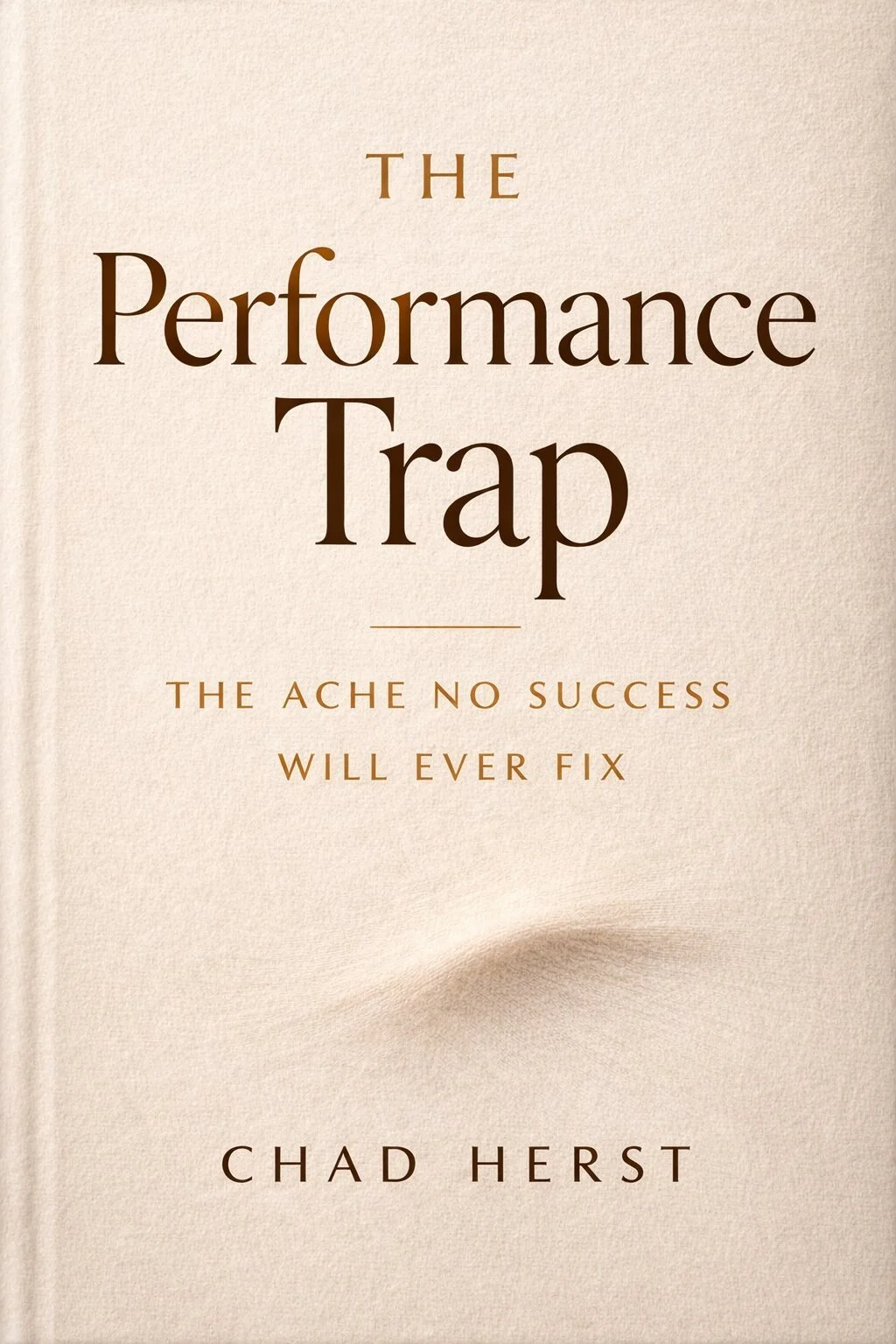
A BOOK BY CHAD HERSTFor the one who can't stop achieving but never feels enough. For the one stuck holding everyone else together while their own needs got buried. For the one who learned that needing anything made you weak.
The den
I'm sitting in my grandparents' den. The fire is crackling. The scent of leather hangs in the air. There are matchstick carrots, celery, cucumbers, and black olives on the tray, each in its own neat pile. My feet barely touch the floor, but I'm holding my soda water with a single drop of scotch in it. A watered-down echo of the drink in my grandfather's hand.
They're talking about someone who admitted he couldn't handle things on his own. The tone in the room isn't just disappointment. It's disgust. As if needing anything, comfort, care, a hand to hold, was pathetic. Proof you don't deserve respect.
I turn to my dad. "What's a schnorrer?"
My grandmother waves it off. "Nothing you ever need to worry about, Chaddy boy."
But my grandfather sets his glass down, looks at me for a beat, and nods. "Schnorrer is a Yiddish word," he says. "It means a beggar. Not just someone who's poor, but someone who can't stand on his own. In this family, we don't lean on others. We're not weak."
“There are only two types of people in the world: the doers and the schnorrers. And in this family, we are doers, not schnorrers.”
In that den, with the fire crackling and the olives on the tray, the world split in two. No third option. You were either strong or you were nothing. No room to need. No asking for help. I was seven, and the rule had already been written.
What I didn't know then was how far that rule would push me. Or how many of us live by rules we never chose.
The cost
No matter how well you perform, some moments cut right through the act. Mine came in the fall of 1991 with a phone call. My brother had taken his life.
After that, my ability to perform just disappeared. I still went to class, showed up to fraternity parties, hit my marks on stage. But it was like moving through fog. My body felt heavy. Everything was dimmer, quieter. I was going through the motions, but I wasn't really there.
Grief doesn't give two shits about performance. It forced me to look for the part of me I'd left behind in my grandparents' den. The needy, vulnerable side I'd learned to hate. I wasn't even sure that part was still there.
So I did what high achievers often do when things fall apart. I took on a new role. Before, I was the performer. Now, I became the seeker. It was a different role, but still a mask to hide my weakness.
That search took me to India, halfway around the world, with a one-way ticket and no real idea what I was looking for. It wasn't a noble quest. I wasn't running toward something. I was running from grief, and the question of whether I had any self left under the act.
The performance held for a while longer. Then, eventually, my body stopped letting me get away with it.
The cost
No matter how well you perform, some moments cut right through the act. Mine came in the fall of 1991 with a phone call. My brother had taken his life.
After that, my ability to perform just disappeared. I still went to class, showed up to fraternity parties, hit my marks on stage. But it was like moving through fog. My body felt heavy. Everything was dimmer, quieter. I was going through the motions, but I wasn't really there.
Grief doesn't give two shits about performance. It forced me to look for the part of me I'd left behind in my grandparents' den. The needy, vulnerable side I'd learned to hate. I wasn't even sure that part was still there.
So I did what high achievers often do when things fall apart. I took on a new role. Before, I was the performer. Now, I became the seeker. It was a different role, but still a mask to hide my weakness.
That search took me to India, halfway around the world, with a one-way ticket and no real idea what I was looking for. It wasn't a noble quest. I wasn't running toward something. I was running from grief, and the question of whether I had any self left under the act.
The performance held for a while longer. Then, eventually, my body stopped letting me get away with it.
“There are only two types of people in the world: the doers and the schnorrers. And in this family, we are doers, not schnorrers.”
In that den, with the fire crackling and the olives on the tray, the world split in two. No third option. You were either strong or you were nothing. No room to need. No asking for help. I was seven, and the rule had already been written.
What I didn't know then was how far that rule would push me. Or how many of us live by rules we never chose.