
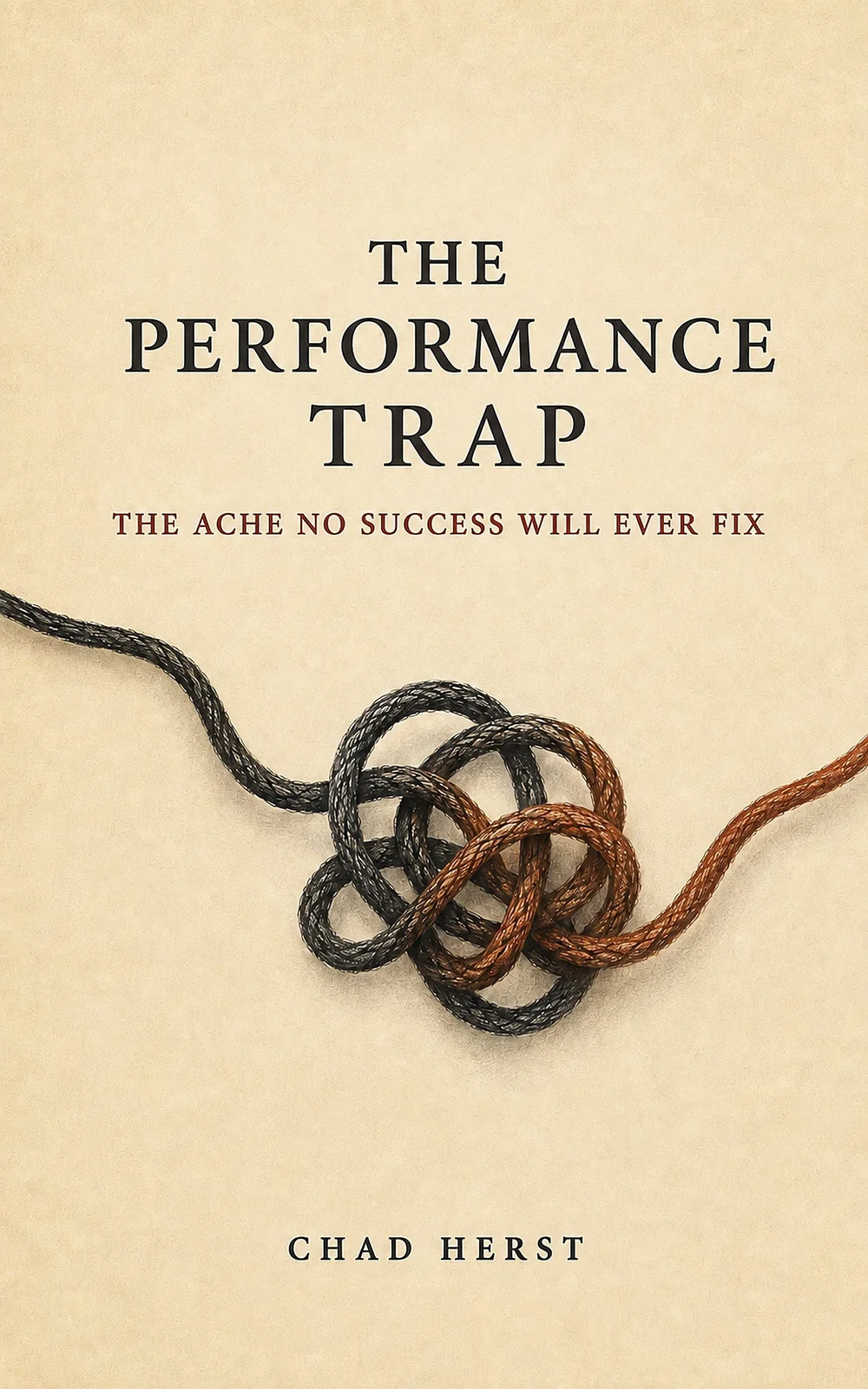
The ache you've been running from isn't the problem. It's the signal. And it's also pointing the way back.
A BOOK BY CHAD HERSTFor the one who can't stop achieving but never feels enough. For the one stuck holding everyone else together while their own needs got buried. For the one who learned that needing anything made you weak.
The den
I'm sitting in my grandparents' den. The fire is crackling. The scent of leather hangs in the air. There are matchstick carrots, celery, cucumbers, and black olives on the tray, each in its own neat pile. My feet barely touch the floor, but I'm holding my soda water with a single drop of scotch in it. A watered-down echo of the drink in my grandfather's hand.
They're talking about someone who admitted he couldn't handle things on his own. The tone in the room isn't just disappointment. It's disgust. As if needing anything, comfort, care, a hand to hold, was pathetic. Proof you don't deserve respect.
I turn to my dad. "What's a schnorrer?"
My grandmother waves it off. "Nothing you ever need to worry about, Chaddy boy."
But my grandfather sets his glass down, looks at me for a beat, and nods. "Schnorrer is a Yiddish word," he says. "It means a beggar. Not just someone who's poor, but someone who can't stand on his own. In this family, we don't lean on others. We're not weak."
“There are only two types of people in the world: the doers and the schnorrers. And in this family, we are doers, not schnorrers.”
In that den, with the fire crackling and the olives on the tray, the world split in two. No third option. You were either strong or you were nothing. No room to need. No asking for help. I was seven, and the rule had already been written.
What I didn't know then was how far that rule would push me. Or how many of us live by rules we never chose.
The cost
No matter how well you perform, some moments cut right through the act. Mine came in the fall of 1991 with a phone call. My brother had taken his life.
After that, my ability to perform just disappeared. I still went to class, showed up to fraternity parties, hit my marks on stage. But it was like moving through fog. My body felt heavy. Everything was dimmer, quieter. I was going through the motions, but I wasn't really there.
Grief doesn't give two shits about performance. It forced me to look for the part of me I'd left behind in my grandparents' den. The needy, vulnerable side I'd learned to hate. I wasn't even sure that part was still there.
So I did what high achievers often do when things fall apart. I took on a new role. Before, I was the performer. Now, I became the seeker. It was a different role, but still a mask to hide my weakness.
That search took me to India, halfway around the world, with a one-way ticket and no real idea what I was looking for. It wasn't a noble quest. I wasn't running toward something. I was running from grief, and the question of whether I had any self left under the act.
The performance held for a while longer. Then, eventually, my body stopped letting me get away with it.
The trap
Years went by. More people came to me for answers. I was still trying to figure myself out, but I found myself sitting across from startup founders, executives, and high performers who seemed untouchable. Their lives looked perfect. But underneath I saw something familiar: the same polished self I knew too well, and the same hidden need.
It wasn't ambition driving them. It was love. Or the search for it. The same search that had driven me onto stages, into India, into a healing profession where I could prove I wasn't a schnorrer by showing up perfectly for client after client.
I started writing about what I was seeing. Then one of them, a founder I trusted, read an early draft and sent me back a single line.
“Why should someone like me listen to you?”
He wasn't attacking me. He was being honest. And it stopped me in my tracks. Because I knew the exhaustion of the performance trap. I'd been living inside it the whole time I'd been writing about it.
That question pulled me deeper. It forced me to stop writing as an expert and start writing as a human being. It made me realize that the pattern I was seeing in my clients, the burnout, the emptiness, the inner critic, wasn't a business problem. It was the result of an old agreement we made to trade our real selves for safety.
“Performance doesn’t always look like success. Sometimes it looks like staying small. Sometimes it looks like holding everyone else together.”
For some, it shows up as achievement. If I win the award, get the title, build the company, then I'll finally be wanted when I walk into the room. For others, it looks like care. If I solve your problems, manage your emotions, then maybe I won't be left behind. And for some, it doesn't speak at all. It looks like invulnerability. If I don't cry, if I'm fine no matter what, then I won't be a burden.
Different disguises. Same root lesson. Just being wasn't enough to stay connected. Something had to be done. Something about you had to change to keep the bond alive.
That adjustment kept you alive. It also became the seed of the trap.
This book is an invitation to break that contract. It's about learning to stop running from the ache of not-enoughness and instead turn toward it. It's about discovering that the very part of you that you've been trying to hide, the part that feels things deeply, the part that needs, isn't a flaw. It's the doorway back to yourself.
BE ONE OF THE FIRSTGet an early copy. Help the book find its people.
Reviews around a book's launch are everything. They're how a book moves from one person's shelf to someone else's search results. If this story resonated with you, I'd love your help getting it into more hands.
Here's how it works:
Sign up below to join the launch team.
You'll receive a free advance copy of the book before it's available to anyone else.
Read it. Then post an honest review on Amazon around launch day.
That's it. No pressure, no script. Just your honest take. If this isn't for you, no hard feelings. You can still support the book by sharing it with someone who needs it.
Listen wherever you are.
Want to be on the show?
If something in this work resonates and you'd be open to a real conversation — not scripted, not polished — we'd love to hear from you.
NOT READY FOR THE BOOK YET?Two other ways in.
You don't have to commit to anything to start.
I
Listen to Chapter One
"The Day the Mask Cracked." Read by Chad in his own voice. The phone call. The brother. The moment everything changed.
II
Take the map
A personalized reading based on the Performance Trap framework. See the pattern that's been running underneath everything.
Chad Herst is a coach and former licensed acupuncturist in San Francisco. Read his full story →
A group experience built on the framework from the book. Not a course. Not a program you complete. A practice you build, with others who recognize the trap.
Something deeper is coming.
765 Market St, San Francisco, CA 94103
(415) 686-4411 · chad@herstwellness.com
© 2025 Herst Wellness. All rights reserved.