
Yoga chad Yoga chad

An Approach to Ashtanga that Supports Aging & Fatigue

Below, is an email exchange I had with a friend in the Ashtanga community, someone who is struggling to find a way into her practice such that it supports her fatigue and depression. I share it because I have the sense that many practitioners silently struggle with these very issues, and I do not believe that the teaching community adequately speaks into these issues.  Often the instruction students receive is, “Keep practicing.  It will change.” And so many fatigued and frustrated Ashtangis, just keep doing the same practice over and over hoping for a different outcome.  Many, however, quit.  Ashtanga is a powerful practice, but there can be an ethos within the community that is unforgiving.  There isn’t a lot of space for those who need to deviate from the standard practice.  It is not uncommon for students to essentially get the message: “You either do it the way it’s taught in Mysore, or you’re not welcome in this room.” 

I share this dialogue for those people who have not been able to find the space within the world of Ashtanga to know that an Ashtanga practice does not have to look just one way and that there is a way for the practice to support you, no matter where you are in your life. 

Dear Chad,

I have had chronic fatigue for many years, and used to find my Ashtanga practice helpful with my energy levels, but lately, I’ve been struggling with the intensity of the practice and have been asking myself, “What the heck am I actually doing?” I do think the Primary Series is very detoxifying, but it wasn't until I went back on antidepressants that I had any kind of ability to maintain my practice. I have been off of them again for 1 year and want to keep it that way.

However my fatigue returns when I try to expand my practice, and my self-practice at home is never very energized.  I feel I need the energy of others in order to really push through my energy issues. And now that I’m in my mid-40’s, I’ve been asking myself, “How am I going to maintain this practice?” Lately, I am always on that line of questioning because it seems that without the pills I cannot maintain my energy, and I am committed to keeping myself off medications.

At this time the support of a community and teacher would be so helpful, but I cannot seem to find it; in fact, I have been greatly disappointed by folks within the tradition who I admire, people I thought would understand and point me in a particular direction.  They’ve neither been kind nor helpful. If you could offer me some advice on how to proceed I would be very grateful.

Thanks,

T


Dear T.

Many within the tradition we come from, unfortunately, promote the notion that we should be able to maintain a vigorous practice no matter what stage of development we're in, no matter how healthy or unhealthy we are.  And that's just not a viable, life-long approach to practice.  The practice that suited me in my early 20’s, for example, no longer fits for me in my 40s. A mature perspective on practice recognizes that yoga should support our health and well-being no matter where we are in life.

When I first started learning the practice, I was 19 years old, so it helped me immensely to have a place to direct all of my energies, both positive and not so positive.  Without it those anxious times might have been met with a lot more self-destructive patterns, like drinking, drugs, and self-loathing.  Having the structure to get up early each morning, to show up on that mat and practice strongly each day was the perfect solution for all that anxiety, self-doubt, and agitation that seemed to be central to my 20s and early 30’s.  But as I’ve gotten older, practicing like that zaps me.

I’ve recently stopped practicing Advanced A.  I find that it stresses me out physically and emotionally.  As I transition into my early 40’s, I notice that all of the arm balances make my neck, shoulders, and upper-back ache and tax my energy. I am at the stage of life where I want to have enough energy to give to my wife, our family, my clients, and my community, and it is a lot to manage.  At some point in the last few years I woke up to the fact that I did not want to keep giving all my energy to my practice.  I wanted my practice to be able to support me, to support my life, to support my pursuits.

And these days, I’m just starting to be okay with the fact that my practice might look different each day.  I tend to stay on the six day per week schedule, but I no longer beat myself up if I don’t get to it that often.  If I, at the very least, get on my mat four days a week, I feel like I’m on track.  After all, I’m not trying to “kill it.”  I’m not pushing into the next pose or the next series. I’m maintaining my health, vitality, and clarity to face my life.  While I practice primary and intermediate series most of those days, I may or may not complete the whole series of postures.  I usually jump back between sides, but when I don’t have the energy, I don’t push it.

I especially don’t push it when I have an injury, am sick, or don’t get enough sleep.  Melissa, my wife was up all night with the flu last week, which meant that I was up, too.  When I got on my mat the next morning, my head was spinning.  I wasn't sure if I was coming down with the flu, myself.  So after the Ashtanga Invocation, instead of starting Suryanamaskar A, all I had the energy to do was to take padmasana; do ujjayi pranayama for about 30 minutes; and then take a 45-minute savasana.  Yep, that was my practice.  And, yes, I still consider that Ashtanga Yoga. I did not, in fact, get sick.  I had eight clients that day, and had I not taken care of myself, I would have been a mess.

It is my sense that the practice continues to evolve as we get older.  When I was in Mysore in 2005, I was told that someone I was practicing with in the shala in his mid-50’s was taking anti-inflammatory drugs in order to continue practicing Advanced A and B.  His practice looked quite acrobatic for someone his age, but was that practice supporting him or was he supporting it?  What’s clear to me is that as the body evolves, so should we.

Krishnamacharya, Pattabhi Jois’ teacher, divided yoga practice into various categories, called krama, which means a step used to achieve a particular goal.  As we get older, our orientation moves from athletic perfection (siksasana krama) to maintaining our health and preserving our youth (raksasana krama).  Eventually, our orientation moves to adhyamatya krama, or spiritual matters. (1) We tend to move our practice in this direction in the time of life we in the West tend of think of as retirement.  It occurs in our culture when we are in our 60’s or 70’s.  Our focus turns toward questions about the meaning of life. And so the orientation is less in the way of getting and staying strong and flexible in the body. I am not suggesting that it is unimportant to maintain health and vitality as we age, but that the 60’s onward are about developing wisdom, and that comes about primarily through stillness practices, like meditation. (2)

I cannot personally speak about this stage of development because I am not there. I do know several Ashtanga practitioners in their late-50’s and 60’s who do not keep the same practice they kept when they were in their 20s, 30s, and 40s, but they’re not very public about how their practices have changed; in fact, about a year ago, I asked an old friend who has been practicing since the 70s if he would be willing to be interviewed for this very question, but he declined.  He did not want to expose himself to criticism.  I completely understand his perspective.  When someone speaks about altering the practice to even the slightest degree, some people who have elected themselves to be the “yoga police” within the community launch in with vitriolic abuse. Nevertheless, I do sense that it would be very healing for all of us to learn how our teachers and mentors evolved their practices to account for the physical, emotional, and spiritual changes that occur with aging.

As far as I can see, T, you can take the practice we're taught and break it into component parts that support you energetically and spiritually.  Maybe one day you skip all jump-backs and jump-throughs to prevent fatigue from setting in.  Maybe on another, you practice only a few postures paying particular attention to your breath and bandhas and only go as far as you can keep your attention.  When you notice it flagging, you stop. Maybe on another day, you wake up feeling ungrounded, so you just do the standing sequence, holding each posture for 10-20 breaths.  Or maybe the mood needs lifting, so you focus on back bending, chest openers, and emphasize inhales and inhale retentions.  The variations are endless.  What’s required is the willingness to take the dive, to experiment.

Yes, it can be helpful to have a teacher who has already walked down this path, someone who can show you the way, and it can also be extremely helpful to have a place with group support where your experimentation is welcome, but there are not many Mysore rooms or teachers that are ready for a student like you, not yet, at least.  So you have to be willing to develop a home practice and then also be equally willing to take risks, read, and just keep showing up on your mat with curiosity.

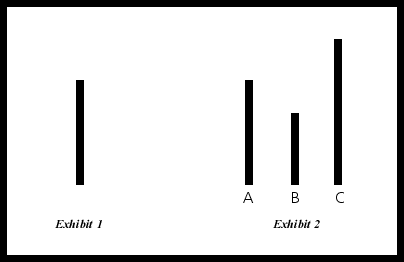
In closing, I recently heard about this experiment called the Asch Paradigm where they put 10 people in a room.  9 of the people were shills.  1 was not.  They showed all 10 cards with lines of different lengths.  Two of the lines were clearly of equal length (Exhibit 1 and B) while the other two (A and C) were not.

asch_conformity

The researchers asked the nine shills to claim that two badly mismatched lines (B and C) were actually the same, and that the actual twins (Exhibit 1 and A) were total misfits. The one person who was not a shill almost always went along with the other 9 members.  Why?  When they quizzed the victims of peer pressure, it turned out that many had done far more than simply go along to get along. They had actually shaped their perceptions, not with the reality in front of them, but with the consensus of the multitude. (3)

In short, what I'm suggesting is that you're not weird or unusual in your experience of the practice.  That you're fatigued from it is pretty common.  My question to you is whether you have the guts to trust your own intuitive sense that something is off and find an approach that supports your well-being and that supports your mood.  That can be a huge challenge, especially if you're used to the support of the Mysore room to carry your practice as well as the support of a teacher and friends who share a mutual love for the system.  It's hard not only to stand on your own, but to trust your innate knowing when everyone around you is telling you that you’re crazy when, in fact, you’re not.

I hope this helps.

Chad


Footnotes:

(1) So for example, B.K.S. Iyengar reported that “In 1978, after my 60th birthday celebration, my guru (Sri T. Krishnamacharya) advised me to devote time to meditation and to reduce my physical strain.” (Iyengar, B.K.S., Astadala Yogamala. New Delhi: Allied Publishers Limited. 2001)

(2) I’m not suggestion just because one has reached a certain age, they should stop doing the Ashtanga series.  If someone has the inclination, time, and energy to devote to progressing through the series and they’re no longer young, by all means, I think it is important to follow that urge.  It can be incredibly life affirming to practice advanced postures and to push the limits on what’s possible in this human form.


Read More
Yoga chad Yoga chad

Five Element Series Part 6: Fire Element

Fire brings heat to the body, mind, and spirit. The range runs from warmth to desire to rage. In its milder forms it shows up as the warmth and generosity we bring to the people we love. In its stronger forms it's aggression, tension, hostility, lust, the whole scary end of being alive.

Some spiritual teachers have an awkward relationship with this element. Where the teaching aims at transcendence, students get told to overcome passion through suppression rather than transformation. And suppression produces a particular character: the aspirant who is pretending to be blissed out and is, in fact, furious. Ram Dass called the sexual version the horny celibate. The bliss is a performance, and the anger underneath is what the performance costs.

The fear of fire is fair. We've all watched a sentence said in rage end a relationship. People who kill say, I was in a fit of rage, I wasn't in my right mind. Playing with fire takes skill. But if we never learn to use it, we lose a whole side of life: expression, warmth, passion, adventure.

Here is where it gets practical. Anger is the signal that a boundary has been crossed, a boundary marking something we cherish. A value, someone we love, ourselves. Handled with some proficiency, that signal becomes the capacity to say no and mean no. Without it, we say yes and mean no, and then we feel ripped off and used. The no we swallow doesn't disappear. It comes back as resentment, and anger expressed from resentment creates more chaos than the clean no would have.

Repressed fire also finds vices. Coffee, spirits, cocaine, pornography. The addictions give the fire somewhere to go. They just burn us and the people around us without transforming anything.

The yogic tradition takes fire seriously. The fire in the belly, agni, metabolizes food and experience alike. Tapas, the heat of practice, is the capacity to stay with discomfort long enough to see into it. The practice builds that heat deliberately: moving quickly between postures, more sun salutations, a louder exhale, an arc of intensity that peaks and then comes down into ground and clarity. On the other side of expression there's usually both.

When there's too much fire, water balances it. Sadness, longing, the deeper and slower feelings cool the hot ones. So does simple kindness turned inward, the metta phrases: may I be filled with peace, may I be safe and protected.

But the first move is smaller than any of that. Notice where you said yes this week and meant no.

I wrote a book about that. The first chapter is twenty-eight minutes, read in my own voice. Enter your name and email and I'll send it to you.

Read More
Yoga chad Yoga chad

A Living, Breathing Practice

1462139_orig A group of friends and I have started to gather at my house monthly to take a deeper dive into Yoga than the kind we get when we go to the yoga studio or even when we do a teacher training.  The problem with teacher trainings is that there's so much to cover in terms of content, that we don't have a lot of time to linger on some of the deeper questions, like what on earth is yoga about?  Or what's yoga to me?  Or how did the ancients view yoga and spirituality?  And how does it pertain to my life?  It is my sense that we all have to ask these questions, to not just accept techniques like asanas (yoga postures) or meditation without an analytical consideration.

And because Yoga has the propensity to be embodied and non-analytical, we're not  encouraged to go here a lot.  My teacher, Pattabhi Jois,is often quoted as saying, "Yoga is 99% practice, 1% theory."  How often do we hear the instruction, "Drop the the thought and return to the body," or "Your thoughts are like passing clouds.  Notice the thought, and come back to the breath."  This is really the heart of spiritual practice, just noticing.  And most practice, if it's effective, takes us out of our thinking, comparing, and analytical mind and into a more intuitive, sensing, feeling, and non-thinking place.

But that's not to say that the spiritual experience is, strictly speaking, a non-thinking experience.  Actually, there's a lot of thought, in fact, thousands of years of thought, about the spiritual life and the spiritual experience that we can draw from.  There are a ton of maps written by those who have walked the path before us that we can use to understand and make sense of our own journey.  It is not only important but should be mandatory for all of us who are deeply seeking to understand the traditions we come from.  That way we can start to contextualize them and make sense of them.  More importantly, I think it's imperative that we develop a critical eye for our spiritual practice and the teaching associated with it, so we can choose a path that takes us to where we need to go rather than where we're told we should go by a teacher, a teaching, or a community.

The Sutras Through a Critical Eye

As I was preparing for our last gathering, I came across an interesting podcast by Matthew Remski that really had me questioning how much authority I wanted to place in The Yoga Sutras as a map for my spiritual practice.  Remski points out some of Patanjali's weird views.  Examples include:

  1. The idea that Yoga is about such a complete separation of awareness (purusa) and nature (prakriti), that it veers in the direction of disembodied, spiritual bypass.  In other words, the cessation of the fluctuations of consciousness (1:2) lead to a recognition that one's true identity is not this body; this entity I call me; or these relationships I surround myself with.  These are all fluctuations within awareness.  Through a gradual process of detachment, we see that these things are ephemeral, and thus, not eternal.  The awareness (purusa) that notices these things that arise, stay for awhile, and pass away is eternal, and, thus, our true identity.  Extreme form of non-attachment, like the one espoused in The Yoga Sutras, has the potential to validate the avoidance of practical challenges or difficult or painful feelings or memories.  This stark dualism, separating awareness and all the things within it tends to unground people and unseat them from their innate wisdom.
  2.  The fourth chapter, Kaivalya Pada, commonly translated as chapter on liberation is a mistranslation. Pada means subject.  Kaivalya actually means perfect isolation; thus, one of the end goals of a good yoga practitioner, according to Patanjali, is to detach so much from nature (prakriti) so as to separate from society, as a whole.  Yoga was heavily influenced by the monasticism of Buddhism and Jainism.  In fact, the ethical precepts, the yamas and the niyamas, come from the Jains who believed that separation was a necessary ideal to experience complete liberation, that to be in contact with others leaves the yogi vulnerable to the negative karma of another.  In our everyday language, this is another way of saying that liberation requires that we stay away from others so as not to pick up on their bad vibe.
  3. The book is chalk-full of  magical thinking.  For example, intense forms of absorption lead to one's capacity to fly or inhabit the body of another and make that body move.

Remski's analysis--which is brilliant by the way--forces us to look twice at this text that we yogis tend to hold with reverence.  Without a doubt, much of the instruction in The Sutras is erudite and brilliant.  Developing a capacity to practice anything with non-attachment (vairagya) (1.15) is a simple and brilliant instruction on how to learn anything.  The tools that the Sutras offer us on how to witness and what to witness are fabulous instruction for each of us who would like to develop greater capacity for objectivity.

But how far do we intend to take this process?  In its most extreme form, it could lead us away from our relationships, away from community, and either into monastic life or a cave in the Himlayas.  Or maybe what we're looking for is just an hour in the day "where you don’t know what was in the newspapers that morning, you don’t know who your friends are, you don’t know what you owe anybody, you don’t know what anybody owes to you. This is a place where you can simply experience and bring forth what you are and what you might be. (Campbell, Joseph; Bill Moyers (2011-05-18). The Power of Myth (p. 115). Knopf Doubleday Publishing Group.)

Bringing Old Texts to Life

As I said before, I'm not suggesting that we ignore the classic texts.  They're giving us hints that can help us immensely on the journey.  But if we are on the path, we have to take responsibility for our journey.  Doing so requires that we look with a critical eye.  When we accept these maps on faith we sometimes end up in places we never intended to be.   A lot of the orthodox approaches within the Buddhist and Yogic tradition posits the notion that because we're too rife with avidya (misunderstanding, misapprehension, or spiritual ignorance), we cannot possibly see what will help or hinder us on the journey.  That's why we need not question the authority of the teacher, the teaching, or the community but, instead to have faith in their innate validity.

There's a third approach to working with the teachings of a tradition. We don't take them at face value, and we don't ignore them.  Instead, we struggle with them.  We see them as texts written by human beings, like you and me, and who were writing for a particular audience living in a particular moment in history with a unique set of struggles.  And then we work with the text to separate that which is essential truth for us from that which is particular to the times and perspective of the writer.  And then we try to make sense of it for the current situation we find ourselves in.  This how a tradition becomes a living, breathing, and evolving thing.  And if you consider it, we are the critical link to the evolution of the tradition.  How each of us interprets and makes sense of any tradition determines how it will be carried forth from one generation to the next.  In short, to go through this process is to take responsibility not only for our spiritual path, but to create new maps, maps that one day will influence seekers, like us.

Read More
Yoga chad Yoga chad

Ashtang-ulous!

Earlier this week, I noticed that a bunch of my yoga friends on Facebook were commenting on some notes from a conference led by Sharath Jois.  Sharath was giving a talk partly on sirsana (headstand).  According to the notes that were so generously shared with all of us by Megan Riley, sirsana not only benefits circulation, but it "help[s] to draw our Amrita Bindu, these golden drops of nectar that, over time, fall down into our digestive fire, back to the head.  [Amrita Bindu] drops as we age, and keeping it from burning away will keep us looking youthful and bright." When I read this, my first reaction was, "Come on?  A golden nectar that keeps us looking youthful and bright?  What's this?  Sounds superstitious to me."  I could understand how a headstand could alter circulation, facilitating the return of pooled blood into the heart, but no science books that I'd come across had located or described golden drops of nectar within the head that when preserved through inversions keep us young, if not immortal, and radiant.

And yet, over the years of being a student of this tradition, I've come to realize that it might not be useful to just blatantly disregard the teaching just because it doesn't fit within my immediate understanding of reality.  I've grown so much over the years as a human being and yoga student by grappling with concepts within the tradition that initially seemed foreign, otherworldly, and, at times, magical.  When I've applied a practice of openness, curiosity, and experimentation to the teachings, I've tended to learn more and, at the same time, grow more.  This isn't always easy for me to do. In fact, this notion of Amrita Bindu is part and parcel of various aspects within the tradition that, even to this day, still trip me up.  Examples include:

  • Ashtanga comes from an ancient text, The Yoga Korunta, written by Vamana Rishi, and is 5000 years old.
  • It is 'incorrect method' to alter sequencing, modify the poses, or include props into The Practice other than adjustments.
  • Do not practice on moon days because injuries on these days take twice as long to heal.
  • When taking padmasana (lotus posture), the left leg should always be on top of the right.  This clears the liver and spleen, straightens the spinal column, and helps the aspirant to maintain strength.
  • Yoga students should eat primarily milk, ghee, and chapatis in order to develop strength because they promote a sattvic (clear) mind and strong body. Avoid eating many vegetables.  Do not eat garlic, onions, tomatoes, or any meat.
  • Drink coffee before practicing yoga because coffee is prana (life force).
  • Don’t wash or wipe your sweat off  but massage it into the body after practice in order to make the body strong and light.
  • Men and women should only have sex:1) at night 2) when the man's left nostril is open 3) when the woman is between the fourth and sixteenth days of her menstrual cycle 4) only for the sake of having children 5) only when lawfully wedded.
  • Never breathe through the mouth because it creates heart troubles.
  • When you make the Darth Vader sound associated with Ashtanga breathing--also known as ujayi pranayama, but technically within the Ashtanga tradition, the term ujayi is restricted to a form of pranayama practiced separately from asana practice-- you increase internal heat, which thins the blood and purifies it.
  • Mula bandha should not be restricted to asana (posture) practice alone but should be practiced while walking, talking, sleeping, and eating in order to maintain mind control.

Not Saying, "Yes" But Not Saying, "No," Either

On first blush, a lot of the rules mentioned above seem a little dogmatic; at times, occult; and, in almost all cases, exotic.  I want to suggest that as Western educated yogis that we both refrain from blatantly disregarding them, and at the same time, not thoughtlessly absorbing them.  Instead, I think it's important that we learn to develop the practice of applying critical thinking.

While there's no doubt that The Practice is powerfully life-changing, it does not mean that as practitioners of this method that we completely surrender our capacity to discriminate.  It's important to be able to question what we're told.  As far as I am concerned, I think it's a sign of a mature practitioner that uses her hesitancy as a tool to learn.  Without it, we run the risk of being pollyanna-ish about everything that's presented to us. If we don't simultaneously apply the qualities of openness and curiosity, however, we run the risk of never growing out of our small bubble, of being arrogant, and of being lazy.  Being stuck on being right and knowing it all is a form of laziness.  The student never has to discover her misconceptions, nor does she have to struggle to learn.

And learning is rarely a passive phenomena.  From where I stand, I can see that it would take me several lifetimes to learn all that this practice has to impart.  Guruji's knowledge was vast and his teachings, which, on the surface, sometimes seem simple, are, in fact, quite deep.  I have no doubt that to grasp the depth of the wisdom he imparted would take me many lifetimes. And because I don't come from his or Sharath's culture, I have to struggle to put their words and experience into my life and into terms that make sense for me.  I can't just take them at face value.  I have to try to make sense of them on my terms.

I think that that's part of what makes this practice so challenging for us Westerners.  Terms, concepts, and world views are, at times, diametrically different in India than they are in the West.  There's no doubt that we're all after the same things: peace, wisdom, compassion, and happiness, but how we express the path can be quite different.  What's required as Western students of this tradition is the work of bridging the cultural divide by translating The Practice into terms that are both culturally and individually relevant so that they simultaneously breathe new life into our practices and perspectives on life.

Santa Claus Isn't Coming Down the Chimney Anymore

I sometimes wish that I could just have faith in someone else's words and let that be enough.  I don't think I am alone in my longing.  Having faith doesn't necessarily come easy to a lot of us in the West.  For a lot of us, faith is like still believing in Santa Claus.  At some point we all discover that he doesn't necessarily come down the chimney, that that's just something someone told us.  And when we're old enough to discover this, it can be heartbreaking, but that experience awakens us to something else, the capacity to question what we're told.  And this questioning can be very useful in the times we're living in, especially when our advertisers or our politicians are trying to get us to buy or vote for things that don't serve us.

But at the same time, in spite of our capacity to apply critical thinking, we in the West aren't, on the whole, necessarily a happy culture.  We may be rational, but we're missing a sense of meaning, a sense of order to life.  A lot of what we face in the West is a sort of spiritual wasteland.  So when we look to lineage-based traditions from another culture, like Ashtanga, that are rooted in the wisdom of antiquity, we can't help but want to find the magic, again.

I remember when I used to think that if I did my asana practice six days a week for the rest of my life, "All was coming."  At some point along the way, though, I discovered that Santa wasn't coming down the chimney of my practice, either.  There is no doubt that the practice is an immensely helpful force in my life and has been over the last twenty years, but it's not perfect.  It has helped me overcome the trauma of my brother's suicide; it introduced me to an international family of like-minded people; and it has created a lot of meaning and order to my life.  But it doesn't and can't solve all the woes that ail me.

I completely understand the urge to want to buy the system and everything about it as perfect.  It's so tempting to  do.  And over the years, I've seen lots of my yoga friends initially do this but eventually, something snaps.  I can't tell you how many former vegetarians I've known in The Practice, or people who were incessantly talking about postures and what pose they were on in Mysore, and then, at some point, drop the thing altogether.

One friend of mine had spent a few years living and studying in Mysore.  Like me and like so many others I know, he came to Ashtanga, initially, to heal old wounds.  Early on in his studies, he spoke about, practiced, and taught Ashtanga Yoga with the fervor of a "true believer."  Every other sentence out of his mouth would be a quote from Guruji: "Slowly, slowy, you take." "In-correct!!!" "Yes, yes, you come!"  Eventually, this parroting became a little creepy to me, and I kind of wanted to tell him to cut the crap, but eventually, he got injured.  And while he struggled to continue to practice and teach, at some point the message and the method stopped making sense to him. His conscience would no longer allow him to teach or practice what he eventually saw as "a bunch of bullshit."  This is just one story of many more stories I could recount of friends who started gung-ho, but eventually recognizing that something was askew.

Having Faith in Skepticism

From my perspective, what was askew was not necessarily the teaching, but that my friend didn't maintain his healthy skepticism. When we surrender our capacity to discriminate, we actually  end up suppressing a significant part of our identities, something that we need in order to both get through life, but also to maintain our sanity within the confines of groupthink. In short, it's really a significantly important part of The Practice to question and struggle with the discrepancies between what's taught and what we, in fact, experience.  One of my favorite quotes on this matter comes from one of the most renowned Indian yoga gurus in history, Siddhattha Gotama Buddha.  He said,

"Do not believe in anything simply because you have heard it. Do not believe in anything simply because it is spoken and rumored by many. Do not believe in anything simply because it is found written in your religious books. Do not believe in anything merely on the authority of your teachers and elders. Do not believe in traditions because they have been handed down for many generations."

To me, the Buddha is saying that part of our job as yogis on the path is to use the practice as the vehicle to work with the teachings.  We don't just buy whatever we're told.  We use our practice as the testing grounds to experiment with the hypotheses presented to us.

Making Sense of Apparent Nonsense

If we're truly on the path, not only do we not have the luxury of taking things at face value, but we also don't get to blatantly put everything that doesn't fit into our worldview into the categories, "false," "wrong," or "superstitious." A former student of ours used to come to samasthiti (even standing posture) each morning to chant the opening prayer, but he refused to join in with the other voices.  When I asked him why he didn't, he said indignantly, "I am not a Hindu. I don't want to say something that I don't believe in."  So I decided to share an English translation of the prayer with him.

When I asked him what he thought of the opening prayer after reading the translation, he said, "Yeah, like I said, I don't want to chant a Hindu prayer."  So instead of leaving it there, I suggested that we go over the translation of the prayer together.  Instead of leaving the prayer in the category of "someone else's sentiments," I wanted him to see where, in fact, the words might actually mean something to him.

So we spoke about the first verse of the invocation, which is about having gratitude for the teacher that helps us overcome samsara.  Samsara is often translated as conditioned existence.  It's this idea that we keep being reborn from one lifetime to the next until we've conquered our misapprehension.  Once we've done so, we've attained suahavabodhe (happiness in the purity of mind). He liked the idea of overcoming delusion and uncovering happiness, but he couldn't get his head around reincarnation.

So, I suggested that he not get stuck on lifetimes, either before or after his current life, but that he see that within this very lifetime he was in, he'd already experienced numerous iterations of himself.  While something of him had always remained the same, he'd also been a child, a teenager, and a young adult.  As a result of these changes, he'd experienced several lifetimes within this very lifetime, and he was bound to experience more.  He liked that notion that within the various stages of life he had left, that he could intend to overcome the delusions of samsara.

He had a hard time with the notion of bowing down to a guru, though.  "I don't want to give anyone else that much power."  So I suggested a few other ways of holding this notion of the guru, either the guru could be an inner part of his psyche that was innately wise, resourceful, and powerful.  I also suggested that the practice, itself could be seen as the guru, that through the practice, itself, confusions, doubts, and suffering could be overcome.  "Yes, he said, that's true.  I feel so much calmer on the days I practice.  It's on these days that I make better decisions.  Yeah, the practice is my guru!"

That was the first verse.

When we took on the second verse, he had a lot more difficulty.  The second verse of the Ashtanga invocation is about prostrating to the author of the Yoga Sutras, Patanjali, and visualizing him as a serpent with a thousand heads with arms holding a conch, a wheel, and a sword.  On first blush, he said, "This reminds me of pictures of Hindu gods and goddesses with multiple arms.  I am spiritual, but I am not religious, and I don't want to pray to a god, certainly not someone else's."

I explained that the verse is an homage to the author of The Yoga Sutras, Patanjali, and is suggesting that the philosophical backdrop of The Practice rests in The Sutras.  Patanjali is mythologically considered to be a serpent that serves as the asana (seat or yoga posture) of Vishnu, the god of infinity.  As the serpent, he's holding a conch, a wheel, and a weapon or sword.  The conch is symbolic of the music of the cosmos that calls yogis to live noble lives; the wheel represents the wheel of dharma, or the order of life (as opposed to the randomness); the weapon or sword represents the power of discriminating good from bad, right from wrong, and truth from fiction.

I suggested that he hold the image of the serpent with multiple arms as representative of various values.  First, that our practice is rooted in a system of thought that is deep, profound, and life enhancing, that it's not just another form of calisthenics or aerobics.  Second, the symbol of Patanjali as a serpent that acts as the seat of Vishnu might mean that by sitting or abiding in the wisdom of this philosophy, that we have access to our infinite nature. The symbols that the serpent holds call us forth to make life enhancing choices, ones that are noble, moral, and truthful.

My student liked my translation, but to him the Hindu iconography was just "too Indian."  And, he didn't, in fact, know anything about Patanjali.  He'd heard of The Yoga Sutras, but hadn't read them or studied them, so he couldn't see the significance of venerating someone or the words of someone that didn't mean anything to him.  So, he agreed to chant the first verse of the invocation and refrain from speaking the second verse.  As far as I was concerned, I could completely appreciate his decision.  I also asked him if he'd be up to studying the Yoga Sutras, which he said he'd consider.  I appreciated that he'd walked through this process with me.  He didn't just throw the whole thing out as, "Hindu mumbo-jumbo."  He actually did the work.  And in doing so, he could start to chant the first verse of the invocation without feeling like a fake.

For many of us, we need to do this.  It's important to parse out what is, in fact, meant by the teachings.  We need them translated in terms that make sense to our lives. It isn't in anyway shameful to not understand the teachings.  It's only shameful to simply pass them off as nonsense without making any effort, without seeking to meet the essence of the teachings and to allow them to grow us.

I realize that the list that I made at the beginning of this blog is just the tip of the iceberg in terms of what we as Western Ashtanga yogis must struggle with if we are to continue to use our discriminative minds within The Practice.  It takes a sort of courage to give up the magical notion that Ashtanga is some divine sequence of movements and postures passed down to us from time immemorial by a saintly being who lived in a time and a place when everything and everyone was perfect and wise.  That'd be nice if that were the case, but it's unlikely that that's true.  But that doesn't mean that The Practice is all hooey, either.  It just means that we get to and, in fact, have to do our work, including practice and study, to find a way in that makes sense and, at the same time makes our lives and the lives of those around us better.

Read More
Yoga chad Yoga chad

The Age of the Guru is Over…Now What?- Part 2

'The Age of the Guru is Over…Now What?' Series

This is second part in a three-part series.  In the previous posting, we explored what the traditional relationship of guru and disciple was like.  In this postings, we'll examine how this relationship may not apply to this day-and-age.  In our final posting, I posit some ideas of what I think might replace it.  

Guru Projections

We in the West have an awkward relationship with this sort of authority.  We tend to think of the guru-shishya relationship as one of projection.  The shishya abdicates power to the guru by projecting all things parental onto him.  I saw this, and even experienced it, first hand when I studied at Pattabhi Jois’ Ashtanga Yoga Nilayam throughout the 90s. Guruji could play the face of our good father quite well.  He could also be the fierce father, the tender father, the wise grandpa, and many, many more.  Much of the relationship we shared with our guru depended on our unfinished business.  In a lot of ways, many of us were working out our daddy stuff with him, whether we wanted to admit it or not.

Today, I have little doubt that most of the projection I had with him had almost nothing to do with who he actually was, but being a great teacher, he willingly took on the various fatherly roles and allowed us to act them out with him in order to move through some of the leftover childhood stuff.  While a lot of us got great benefit from this form of relating, I saw some of my fellow guru bhai (disciple brothers and sisters) leave the practice altogether because they could never separate the projection from the man that he was.  And some left because when they did, they were sorely disappointed.

Guru or Snake Oil Salesman?

But unlike an authentic guru, who is regarded with great respect in his culture, our teachers in the West are looked upon with a degree of skepticism. We do not have the same opinion of the spiritual dimension that Asian cultures do.  In the audio CD, The Roots of Buddhist Psychology, Jack Kornfield describes the experience of being a monk in Thailand and accepting alms from people who could barely feed themselves. The work of the monks was so important and valued, that the lay community would starve to feed them.

We, in the West tend to hold people of spiritual authority, with doubt and distrust.  Fundamentally we resist being conned.  It is not uncommon to see leaders of spiritual movements initially elevated by their followers and eventually disgraced by those same people.  Just look at the recent John Friend-Anusara Yoga and Diamond Mountain University scandals.  I don’t know the inside scoop, but what’s clear is that students revere their teachers as if they were gods and then they, somehow, fall off the pedestal.  They're human.

But we as a society tend to hold people who run or lead spiritual movements to a higher standard than we hold even our politicians.  Because they’re leading us into spiritual practice, they have to be unblemished by any one of the seven deadly sins; in fact, in some way or another they need to be perfect.


However, when you look closely at the lives of some of the great teachers from the East, the so-called illuminated gurus, what we’ll find is nothing but humans, people steeped in tradition and teaching and, at the same time, riddled with human foibles.  Chogyam Trungpa Rinpoche, the Tibetan spiritual leader that founded Naropa Institute in Boulder, Colorado, had the reputation of drinking beer all day long and had quite an appetite for young women.  Osho, also known as Bhagawan Shree Rajneesh, the founder of Osho Ashram and Rajneeshpuram in Oregon, was addicted to nitrous oxide and also was known for his affairs with his female disciples.  Amrit Desai, the yoga master who founded Kripalu Institute, had to resign as director after his multiple extramarital affairs were exposed.

Does that make these men any less spiritually advanced?  We in the West would like to think so.  It’s quite possible that we want to believe that our spiritual leaders represent the perfect parent, the one we didn’t grow up with.  The truth of the matter is that we all make mistakes, sometimes even very big ones, ones that hurt others badly.  I am thinking, at this moment, of the priests who mistreat(ed) children.  Without a doubt, this behavior is inexcusable; however, it demonstrates that we can no longer afford to completely relinquish our power to the charismatic individuals that lead our spiritual movements.

God is Dead

These people are human, just like you and me.  Perhaps there was a time when there were gurus who were truly unblemished, but we’re living in a very different period, historically speaking.  When Nietzsche said, “God is dead,” what he meant was that we can no longer rely on the church, the mosque, the monastery, the lama, the guru, or even a philosophy for our salvation.  For him, these forms of authority had become completely discredited.  As a result, it was up to each of us to find our way.

I am not suggesting that we do it alone.  We need others to support our growth and development, but when we are always looking for the wisdom, the compassion, and the answers outside of ourselves, we forget that we're just projecting.  It can help immensely to love and revere our teachers while simultaneously never forgetting that that which we love and revere is The Self.  Essentially, what I am arguing is that when we take the projections back, when we take responsibility for our own transformation, we stop the game of elevating teachers or the spiritual lineages we come from in a way that does not serve us.  Likewise, we also stop being disappointed when our gurus turn out to be human, just like you and me.

In the next post, I will offer an alternative to this traditional guru-disciple relationship.  Be sure to check in early next week.  You can also subscribing to our blog on the upper left corner of this page or returning to our site in the next few days.

Read More
Yoga chad Yoga chad

Chit: Noticing What Is

In my previous entry, I discussed Sat-Chit-Ananda, an ancient yogic compound of three Sanskrit roots: sat, chit, and ananda, that describes the qualities of the experience of yoga.  I spent most of that blog entry discussing ananda, which I translated in our everyday language, as "the yum."  By "the yum," I mean that profound experience that something deep inside is fed and, thus, resonates profoundly.  We all have an experience of this from time to time.  It shows up in those moments when life is especially rich, rewarding and poignant.  "The yum" is our truth; it's our essence; it's our raison d'être.  And essentially, I made the case for the idea that "the yum" is what we're after in the practice of yoga.

Eyes Unclouded By Longing

In this entry, I intend to speak about chit, which is really "the doing" of Sat-Chit-Ananda.  It's the action we must take to uncover, and meet "the yum."  Chit is often translated as understanding, comprehending, or the fixing of the mind.  The action that leads to such an outcome is, essentially, observation, the simple act of noticing.

And it's not just any old noticing, it's the kind of noticing that occurs when the "eyes are unclouded by longing." (Tao Te Ching).  It's a kind of looking, listening, feeling, tasting, touching, and intuiting that allows us to see into things but is not obstructed by stories, dramas, or any interpretation whatsoever.  It's really just noticing what is.  The action of chit, as described in The Yoga Sutras is an active form of observation without interpretation.  When we really get to know things without immediately jumping to conclusions, when we can just notice with curiosity, openness, and a quality of freshness, we come to know them as they are.

The Habits of Seeking Relief

We rarely see this sort of observation applied on the geopolitical stage.  Instead of curiosity, what tends to show up amongst enemy nations is distrust, accusation, manipulation, coercion, and combativeness.  At the heart of this form of noticing are human emotions that are difficult to be with discomfort, distrust, and, more often than not, fear.  This doesn't just happen among nations.  It also occurs in our everyday relationships.

A few years ago I was coaching a married couple, who claimed to have "the perfect sex life," but they just couldn't get along.  Both had plenty of justifications as to why the other wasn't being a good husband or wife.  He complained that she was "passive aggressive" and always found ways of deflecting responsibility for their arguments.  She would argue that he was domineering and even, at times, dictatorial. When we first met, the two of them tried to get me to see their respective interpretations of what was wrong with their partner.

She'd say, "I don't want to argue.  I just want to feel the way we felt when we first got together."  He'd rebut with, "I am not trying to start a fight.  Come on, Chad, can't you see how manipulative she is?"  At the point in our conversations when both had uncovered and identified the manipulative games they played with each other, I asked them, "Well, what's here if you're not playing out this psychodrama with each other?" Immediately, the masks came off, and what revealed itself in the space was raw, passion, and it was so palpable in the room, but neither of them could just be with it without reacting to it.

Being With What Is

Part of chit is really the capacity of being with things as they are, without interpretation, reaction, or labeling.  And there's so much we have great difficulty being with.  Like the couple above, a lot of us have a hard time being with our passion.  Instead of just experiencing it, we tend to jump to the conclusion that it means something like, "What does he want from me?" or like, "I don't deserve her."  We also have difficulty being with certain feelings in our bodies, like anxiety, sadness, anger, and even joy.  Before we will ever really let ourselves just feel what's coming up emotionally, we are often already seeking a solution that will get rid of the discomfort.

That's what "following the yuck in order to get to the yum" is all about.  Something occurs, like somebody says something to us that makes us uncomfortable, and then, before we actually give ourselves the space to just experience the pain, we go looking for a way to get rid of it.  We might seek revenge.  We might go and hide. We might go straight for the pint of Haagen Dazs.  This is just habit.  It's the habit of reacting so as not to be with the experience, as it is.

The Body as the Field of Experience

We know the world through our bodies.  All we need to do is slow down enough just to notice what's coming up, what it's feeling, and meet the feelings with curiosity and openness.  But being able to slow down and notice isn't necessarily easy.  That's why we practice daily and why the Yoga Sutras state that when practice is done steadily and for an extended period of time, we develop a solid foundation (1.14).  It takes continuous practice to get the hang of choosing the direct experience through the body over the reactive, interpretive reality that our discursive minds create.  In other words, it takes a lot of clarity and years of practice to be with both the pleasure and discomfort that shows up in our body without seeking gratification.  One of the benefits of daily practice is that we get the hang of being with the initial discomfort when we have to choose something that in the short-run doesn't feel so good but is ultimately for our highest good.

A student came to class today with some tears.  She was sad but proud of herself.  Yesterday, she broke off a relationship with someone who she cared about but didn't see a future with.  As she put it, "the relationship wasn't heading in the direction I wanted it to go.  Breaking it off is really painful, but I know that, in the long run, it's the right thing for me."  Instead of holding on to the relationship for another year or two, she knows that deep down inside, she has to let it go in order to meet someone who really does meet her.  Sometimes being with 'what is' doesn't feel so good.  In the case of our student, it's painful, but, simultaneously, there is a feeling, deeper down that something is "right," that it’s perfectly fine to just be with the discomfort, without having to fix it or resolve it.

By the way, our student is creating the yum in her life simply by being willing to face the pain of breaking off the relationship.  Why?  Because she is creating a sort of congruency between whom she knows she is deep inside and whom she is out in the world.  Creating that harmony sometimes requires being with what we fear the most.  In fact, more often than not, it takes incredible courage to make that leap.

Asana: Directing Our Awareness Toward Ananda

The practice of asana (posture) teaches us both how to be with the discomfort when and how to kinesthetically distinguish when the experience of "the yum" is authentic. In Patanjali's Sutras, "the yum" in asana is described as: sthira sukham asana (2.47), the place in the posture that has the simultaneous qualities of sthira, steadiness, and sukha, comfort.  So when we practice asana, we're developing a feel for ananda.   That's why Pattabhi Jois used to say that Ashtanga Yoga is 99% practice and 1% theory.  It's not a passive, intellectual pursuit.  It's active, and it requires the direct experience.

For those of us who practice, we all know it.  Every once in a while we're in a posture, working with the breath a little, refining the alignment, noticing the bandhas, and then all of a sudden there's this deep, resonant feeling of, "Yes," or "Mmm," or "Ahhh," or just emptiness, vast emptiness.  That's the experience of sthira sukham asana.  And it's the experience of ananda.  It's not that superficial pleasure we get when we eat a cookie or drink wine.  It's deeper than that.  There's a sort of profundity, a rightness, a fundamental goodness about that experience.

And it's why Mysore teachers give adjustments in class.  They do it, not because they simply want to force students into a deeper posture, but because they want the student to connect to the deeper resonance that the posture can evoke in the body.  When we get the hang of finding those dual qualities in our physical practice, when we find that sweet spot, we begin to develop the skill for discovering it in our relationships, in our work, and in our lives.

Being at Choice

The funny thing is that the moment we've found that sweet spot, it's gone.  It only occurs in a moment.  So what brought us sthira, steadiness, and sukha, ease, in our asana or in our lives yesterday won't hold up today.  The nature of things is change.  Nothing is constant, so we have to remain flexible, not just in body but in mind, as well.

Part of chit is being aware and open enough to see that we are constantly at choice in how we interpret things.  Usually, we just assume that the way we've interpreted reality is just the way it is and probably the way it will always be.  Consider that your interpretation of this blog would change dramatically if you read it ten years from today or even if you read it one more time.  Yet we have the tendency to think that our interpretation of 'what is' is the way it is, that it's fixed.

But if we will apply chit to an experience and the interpretation of it, we will find two very different domains of reality.  The first is based in the direct experience, which is always here and in the present moment.  The second is rooted in ideas, beliefs, opinions, and judgments, all of which are past oriented. So, for example, as I was practicing this morning, I noticed a lot of heavy and crampy sensations in my back and legs.  That was my direct experience.  I could have interpreted that experience to mean that I was stiff today, certainly quite a lot stiffer than I was yesterday.  Once I made that interpretation, I could have followed that logic and made my stiffness mean something like, "I hate practicing when I am stiff.  I think I'll just skip the rest of the poses I planned to do and go straight to savasana (corpse pose)."

I am at choice only when my awareness is here and now, in the present moment. When I am stuck in my interpretation of what the sensations means, I'm caught in a cascade of decisions, which are all informed by past stories and experiences that have nothing to do with what I am experiencing in the moment.  More often than not, the choices are not appropriate to the situation at hand.  But when I just experience the sensation directly, I am more apt to make choices that are appropriate for that particular situation, choices that bring me back to ananda, to both my truth and to what's needed in the present moment.

Chit-Ananda

It takes incredible patience not to jump straight to conclusions but simply to observe what's here.  Patience is not about waiting without any discomfort.  True patience is really the capacity to wait both with comfort as well as discomfort.  If we will slow down enough and direct our attention to what is here in the present moment without judgment, without labeling, with curiosity, by allowing things to be as they are, we will discover what the well-known and widely respected Ashtanga Yoga teacher, Richard Freeman, calls "the yoga matrix," which he describes as  "the background of unconditional love and absolute support that is the true nature of an open mind" (Freeman, Richard. The Mirror of Yoga: Awakening the Intelligence of Body and Mind. Boston: Tambala Publications. 2010. Print).  This is nothing other than ananda, our truth, our happiness, our wisdom, and the deep, profound sense of the perfection of things.

Sat-Chit-Ananda Series

This is the second part of a four-part series that explores the experience of yoga. Be sure to check out the other posts!

Read More
Yoga chad Yoga chad

Ashtanga Yoga: The Tradition and The Dogma

A few days ago, while a student was coming up from backbends, I noticed that she was breathless and grimacing.  I asked her what was up.  She said that her previous Ashtanga teacher encouraged her to move through the series of movements quickly.  She described how the rapid movement agitated her. Dropping into a backbend and coming back to standing is traditionally taught: exhale go down, inhale come up, and the movement is repeated three times with no pauses in between. As a teacher of this tradition, I was immediately stuck with a quandary.  Do I ask her to keep the traditional vinyasa count, thus, honoring the tradition but compromising her well-being, or do I offer her an alternative route? This is a classic situation that comes up in practice, both as a student of the tradition and as a teacher.  Do I uphold the tradition or honor the well-being of my student?  I think it’s obvious that my students’ well-being has to come first over the tradition, but in honoring the tradition, it can become a very slippery slope between letting go completely and gripping with a quality of rigidity.  In many ways, as a teacher and practitioner in and from The West, the dance of honoring tradition and the individual, at the same time, can be a challenging one.  How do we not lose the essence of the tradition and, at the same time, fit the practice to the individual?

'Correct Method' / 'Incorrect Method'

I, personally, have struggled with this question for quite some time, probably since the first day I showed up in Mysore in 1993 and discovered that in order to bind my legs in a lotus posture (padmasasna), I had to dislocate the meniscus.  Each time I believe I have struck the perfect balance, I find that I have either become too rigid in a particular situation or way too ‘wishy-washy.’  Admittedly, I err on the side of ‘wishy-washy.’  Something about my personal makeup hates imposing right and wrong on my students.  And so much of following the tradition is about right and wrong.  There’s a right way to do the sequence and there’s a wrong way.  Throughout the years of being a student of Pattabhi Jois’, I heard the words “correct method” and “incorrect method.”

Yoga That Transcends Duality

And somehow, in my mind, a good and powerful system of yoga should and must transcend all duality.  Yoga is, after all, about the union of those opposing forces, masculine and feminine, right and wrong, evil and righteous.  In the language of The Hatha Yoga Pradipika, we’re balancing and harmonizing the solar and lunar energies within the left and right tubes or nadis of the subtle body that feed the energy vortexes, called chakras, in order to evoke or stimulate the sushumna, the central channel within the subtle body of the spinal column.  This is an energetic code for the experience of the transcendental experience that occurs when masculine and feminine, right and wrong, good and bad have been harmonized.  It’s a way of saying that a deeper, wider, and more profound reality exists beyond the bounds of duality.  In the Yoga Sutras, Patanjali says that posture should be “steady and comfortable.” (2:46) “It results with relaxation of effort and the meeting with the infinite.”

Fighting through a posture just because the tradition demands us to do it in a particular way takes us further and further away from the essence of yoga.  And I think that this is where, as teachers and practitioners of any system that comes from a different culture--whether it is yoga or Zen— we need to maintain a critical eye.  It doesn’t behoove us or our students to fall into the trap of saying, “because that’s just the way it is.”  It’s simply the way it is as determined by the elite within the system that we’re in, whether it is the charismatic teacher or the agreement of the masses within the system.

Drawing the Line: Tradition vs. Individual Needs

But here’s where the dance gets interesting.  Where do we draw the line between honoring the system our teacher shares with us and yet remain flexible enough to honor our individuality?  I remember having this same conversation with an Orthodox Jew over a meal many years ago.  I asked her why she followed all 613 commandments with such stringency.  Her deadpan response was: “What am I going to do, follow 400 and then drop the other 213?  That’s a slippery slope.  Who am I decide?  That’s in Ha Shem’s [trans. The Name, which is code for God] hands.”     If we were to follow the Ashtanga tradition with the same stringency, then  men could only have sex during the nighttime. Not only that, if “the breath is felt to be moving through the surya nadi [the right nostril], then that is to be regarded as the daytime, and during that period, copulation and the like are not to occur.” (p. 10, Yoga Mala, P. Jois)

Yoga Practice As a Metaphor

The problem, as I see it, is that we’re facing the issue of a literal reading, as opposed to a metaphorical reading of “the practice.” Joseph Campbell, the mythologist, says that myth and the ritual that accompanies it: “ denotes something transcendent…so that you always feel accord with the universal being.”  Myth uses metaphor to denote one kind of object or idea but used in place of another to suggest a likeness. When we fall into the trap of reading myth or ritual and its accompanying symbols literally, we miss the deeper, wider, and higher spiritual implications that they have the potential to put us in touch with.  All ritual--including the practice of Ashtanga Yoga with its precise vinyasas, victorious breathing (ujayi), internal locks (bandhas), and gazing points (dristis)—are pointing to an inner experience, to fields of consciousness that reflect our inner most being.  However, in the practice of Ashtanga, we often mistake the literal for the metaphorical; the form for the formless; the act for the way of being that that act is pointing to.

When I reflect on almost twenty years of practice, it seems to me that there have been periods of time when I’ve gotten stuck in the literal. I have, at times, been lured by the trajectory of progressing from the primary series, to intermediate, and then, eventually to the advanced series. Early on as a neophyte practitioner, I’d even hoped that as I advanced along the series, somehow life would take on a new shine, that samadhi was right around the corner.  But this approach led to nothing more than physical feats that contortionists from Cirque du Soleil do much better than I ever could.

The Trap of Focusing on 'Correct Method' and 'Incorrect Method'

Really, what I discovered was that “correct method” and “incorrect method” really missed the point and only calcified and petrified aspects of my psyche that needed the light of consciousness.  After all, as a young man of nineteen years old, I came to the practice with the hopes of being more connected to something greater, to overcome feelings of smallness, fear, and grief.  But as I progressed along the path laid out for me, instead of becoming more spacious, more connected, my orientation became focused on doing it “correctly.”  I got stuck in a myopic vision of the path of yoga being about attainment of some image of perfection.  In essence, my practice became another place where I had to struggle.

Oh, and what a mistake that was because it lead me away from the essence of the practice.  I mistook the tools at my disposal--like the postures (asanas) or the internal locks (bandhas)--as the path.  In other words, instead of using these points of focus as metaphors that pointed to more profound states of consciousness, I read them literally and used them to be “good,” so that my teachers and the community of yogis would recognize and like me. In addition, my practice, at times, became purely physical.

What Mula Bandha Can Show Us

If, for example, I performed the root lock (mula bandha) throughout the practice, I told myself that I would be able to jump back and jump through with greater ease. Indeed, the engagement of the core muscles does increase strength and agility.  But that literal reading kept that act of yoga simply a bodily feat.  Mula bandha, can also be read metaphorically.  Its magic isn’t just in the physical mastery of it.  Its magic also lies in where it points consciousness. Given that it is at the base of the body, it points us in the direction of the earth, the part of us that is earth element.  Engaging mula bandha might remind the yogi to be connected to the earth no matter how contorted life becomes.  In addition, mula bandha might encourage us that while consciousness has a propensity to disconnect, that the path of the yogi is to stay in form, to use the body as a tool to experience both inner and outer fields of consciousness.  Mula bandha itself might be a meditation into the root of our being, who we are at the most base level: the part of us that is simply a tube eating, digesting, and defecating.

The essence of what I am saying is that as teachers and practitioners of this method, when we get too literal with the practice, we miss the deeper inquiry that the practice offers us.  If it becomes about progressing along the series, doing it “correctly”, only doing it the way it’s done in Mysore, etc. then the depth and breadth that is the promise of yoga might never be tasted or known.  Honestly, having been down that road, I can say with certainty, there is no pot of gold at the end of the primary, intermediate or advanced series, nor is there any great boon from doing it “correctly” or even “traditionally.”

Why Do You Practice?

I like what Cambell says about what we’re after in life.  “People say that what we're all seeking is a meaning for life. I think that what we're seeking is an experience of being alive, so that our life experiences on the purely physical plane will have resonances within our own innermost being and reality, so that we actually feel the rapture of being alive.” (Campbell, J, The Power of Myth, 1998, episode 2, chapter 4, PBS television series, Mystic Fire Video) Some may dispute this, but I, personally, sense that the essence of practice is to access this aliveness.  Nobody and no system has a better clue about how to do that than we, personally.  It helps to try out lots of different tools and stick to the systems and teachers that offer them, but in the end, each of us has to become the final arbiter.  We have to have the courage to ask ourselves, does this resonate?  Is it bringing me closer to truth?  Is it deepening my consciousness?  And if the answer is, “no,” and it doesn’t jibe with the tradition or the teacher, we have to be courageous enough to stand on our own and to continue to seek and discover an access points that do.

Read More