

Let Go ... of Perfectionism
Perfectionism will grind you down, make you afraid of risk and crush your creativity. And the world needs leaders who are energized, willing to go in bold, new directions and who are able to see a variety of possibilities.
Perfect is the enemy of the good in so many ways. It’s a whack-a-mole kind of a goal that is not only unreasonable and unattainable, it will work against your ability to be your best. It will grind you down, make you afraid of risk and crush your creativity. And the world needs leaders who are energized, willing to go in bold, new directions and who are able to see a variety of possibilities.
The Inner Critic, like most five year olds, believes in perfect and is very invested in getting it. Having high standards isn’t a bad thing. Worthy goals will give you direction and motivation. But chasing after perfect will saddle you with persistent feelings of inadequacy and isolation. And almost every leader I know struggles with this.
You, like all of us, have developed a series of defensive maneuvers and personal armor to hide and protect the soft and tender places, the bruises, the scars, the flaws, the imperfections. What are you most afraid of in yourself? What feelings are you desperate to avoid? What truth makes you want to turn away?
It’s difficult to maneuver in full-plated armor. Hair trigger defensive reactions are rough on you and the people around you. If you want freedom and inner peace, you can’t just strip away what’s protecting you. That will feel terribly unsafe and unsettling. Instead, you need to give love to what’s underneath so that it doesn’t need so much protection.
Throughout your development but particularly early childhood, adolescence and young adulthood, you faced experiences that overwhelmed you. These experiences led you to believe that you are inadequate in some way. Your Inner Critic formed out of the need to make up for this perceived inadequacy. It assumes that if it is harsh enough to us, it will goad us not to be so weak, ugly, stupid, effeminate, moody, sensitive, etc.
Even though you’ve outgrown these early traumatic experiences, you still cannot help but think that you lack in some fundamental way. Given the right stimulus—your partner’s look of disgust, a parent’s reprimand or getting laid off—you will find yourself back yet again in that trauma zone along with that mean Inner Critic telling you how incompetent, hideous, irresponsible or naive you are.
That Critic is attempting—in its own unskillful way—to protect you from the underlying feelings of defectiveness. Instead of protecting you, however, it blocks you from experiencing it directly. It dissociates you from the hurt by sending you back into the project known as "how do I fix myself?"
When you were younger, you were inadequately equipped to face or work with this overwhelming pain. Now that you’re an adult and have more emotional and psychological resources than you did when you were young, you’re more capable of facing it. To do so, you’re going to have to start by giving up attempting to be perfect. That day will won't ever come.
It will also require that you see your pain in a new light. Up until this moment, you have considered your suffering to be a mistake. Judging your pain as wrong puts you in opposition to the way of things and the wisdom of the universe. Maybe your challenge is to stop seeing fault in what hurts you, but instead, to consider the possibility that the hurt might have something to show you. That if you listen behind and underneath the urge to erase something wrong, the pain might reveal something important to you.
This is not to suggest that the initial pain you experienced in those fragile states of development was warranted. No child deserves to feel unwanted, unloved, unsafe or violated. At the same time, you might also acknowledge that something important has grown out of those experiences, something that makes you wiser, stronger or more compassionate, perhaps.
Though we might not entirely comprehend the method to the madness known as suffering, we can see its gifts. The practice of gratitude is an attitude in which we hold everything—including hurt, loss and failure—as an opportunity to discover something new about ourselves and the world.
When my brother took his life, I was already facing a particularly vulnerable moment. I had just begun my university studies hundreds of miles from home and I felt lonely, anxious and unsure of myself. My brother’s death and the resulting heartache and confusion distorted and exaggerated those initial feelings of fragility.
One critical instruction I received from a close family friend was not to feed the anger and not to blame. I’m deeply grateful for this advice. Had I allowed myself to fall into bitterness, I would have lost several years of my life to negativity. This isn’t to say that I did not permit myself to feel resentment when it came up—both for the situation and toward my brother. Suicide, while a very personal act, is also an extremely hostile one. But to feed the rage would have only prolonged and deepened the hole I already found myself in.
I’m also indebted to a teacher who taught me the power of perspective, that the way we look at things makes a big difference in how we respond to and experience them. Far too often we believe we do not have the power of choice, that the circumstances of our lives determine our experience. It’s the boss’ fault; it’s because of the long commute to work; it’s because of the limited financial resources; etc. While I had no choice around my brother’s violent death, this teacher taught me that I did have a choice in how I interpreted the outcome of my experience. I could see the grieving process as an impediment or a learning opportunity.
As an impediment, my grief was nothing more than an inconvenience, a waste of time or an unnecessary irritation. Not long after my brother’s passing, I was lost in this disempowering perspective. I’d always heard that my time in university was supposed to be fun, but I felt so vulnerable that I found it nearly impossible to relate to anyone around me. I smoked way too much marijuana as a way to numb my pain. What I found was that this tactic only exacerbated my sense of aloneness and depression.
When, through the guidance and support of my teacher, I could regard my brother’s loss as an opportunity for growth and learning, a field of possibility opened that led me to take my life in a wholly new and tremendously fulfilling direction. This shift was no easy feat, especially given the fact that nobody close to me—neither my friends or family—could guide, understand or support this journey that took me away from plans of college and a career in the family business.
For many years, I felt as if I was walking through a dark house with only my intuition to guide me. I dropped out of university for a period and found myself experimenting with things like yoga and mindfulness meditation, which, at the time, were considered to be for people who were “weird” or “broken.” In spite of the lonely and sometimes frightening nature of the journey, I could sense a mysterious pull to learn as much as I could. The need to heal compelled me to keep going, to seek out teachers and teachings and, ultimately to find my way.
Today I can say with absolute certainty that my brother gave me a gift. Instead of feeling hatred or holding a grudge, I cannot help but feel a reverent love for him and gratitude for the journey his death forced me to take.
When you can see pain as a curriculum rather than a mistake, you begin a new relationship with yourself. That which wounds you might not just be bad news. It might also be the thing that points you in the direction of your authentic nature.
Had you not endured all that you have, you would not be as compassionate or understanding. Your old wounds can make you more resilient and see more clearly. Your pain is what makes you wise.
This is not to say that gratitude is always accessible. It is not easy to recognize the gifts that come out of suffering. Sometimes challenges can be so blinding and daunting that you cannot possibly see the opportunity that is in front of you. Over time and when you are ready, it mysteriously reveals itself.
While gratitude is partly about being grateful for what you have, it’s also about being thankful for what appears to be missing. To hold this perspective, it requires that you give up attempting to determine what is right and what is wrong. In gratitude, each moment is an opportunity to learn from, including the tragic loss of a sibling, the neglect of a parent when you were hurting or the betrayal of a friend or colleague.
All of these experiences, from the attitude of gratefulness, are grist for the mill. On the surface, they might appear like insensitive and cruel acts, but at a deeper level, they are what can propel you to grow, seek, learn and, ultimately, serve.
And to do that, you need to build a big bonfire and burn your perfectionism. The reality is that you are human, just like everyone else. And humans are a Gordian knot of brilliance and shadow, vulnerability and strength. You are neither one nor the other.
Self-compassion may not come naturally to you, but it’s essential. It requires that you accept your humanity and see that you are no worse or better than anyone else. That you, like all beings, deserve unconditional kindness.

Burnout
It's often hard to detect when feeling associated with burnout are just a passing reaction or when it's a message from the deeper interior that change in needed.
Several years ago, I completed burned out in my work. I had started to feel a dimming of interest in a work project I’d been involved in. I'd been co-running a yoga program in San Francisco with a colleague for five years, and I had stopped feeling that magical feeling. I kept bumping into a kind of been-there-done-that fatigue along with a nagging sense that there was something else out there, something unclear waiting for me. I'd had these sort of feelings before. I'd been started yoga programs like the one I’d been co-running for more than fifteen years, so aversion was not new hat. I thought this one would fade like the previous times, but in this case, my frustration persisted.
Sorting Through the Confusion
It's often hard to detect when feeling associated with burnout are just a passing reaction or when it's a message from the deeper interior that change in needed. We all have periods of time when our jobs or our relationships are just kind of blah. That's normal. The notion that we're always supposed to be happy all the time is b.s. Even the best of job or relationships can go stale on us or just irritate us to the core. That's normal as long as it doesn’t last forever.
When that difficulty is prolonged, however, it can be a message that it's time to slow down and reflect on what we're bumping into. Sometimes it is a message that it is time for a change. Deciphering burnout can be difficult, though. It can be immensely helpful to have wise counsel we can trust enough to help us distinguish the wisdom of our inner callings from the voices that deceive us.
I shared the experience with my coach. I said, "Okay, I'm feeling burned out. I'm starting to wonder if it’s time for me to let this project go. I want to name this urge, but I don't want to make a decision just yet. I want to use these next two months to see if, in fact, I am done, or I am just a little fatigued or bored."
Sure enough, after two months, the feelings had passed. I felt reinvigorated by some responses I'd had to some blog writing I was doing about the intersections of yoga and life coaching and started to see that the project I was in was a great platform for the expression of this cross-breeding.
Then a friend contacted me and said, "I'd like to partner with you to do some consulting work in corporations.” I'd really wanted to explore that possibility, but I was too tired to take on another project. I just could not muster the energy to begin. My days were too filled with teaching classes and working with my coaching clients that I couldn't possibly give it the attention it deserved. Not being able to do this left me completely frustrated. Once again, I began thinking that it was time for a change, but somehow I wasn't quite ready.
And then I had this experience that absolutely changed me forever…
Letting Go
After an arduous bike ride to the top of Mt. Tamalpais, I stood on a hillock overlooking the Pacific Ocean, San Francisco Bay, The City of San Francisco, and the East Bay. As I stood there taking in the scenery, I felt a sense of gratitude for the beauty that surrounded me. I started to do a little, improvised gratitude jig, somewhere between a yoga sun salutation and a dance.
As I did so, I started to hear a clicking noise behind me that kept the rhythm. And when I turned around, I saw this raven standing only a few feet from me with a seed of sorts in its beak. The clicking was coming from the raven's beak making contact with the seed, and I had this clear sense that the raven was relating to my movements by keeping the rhythm.
I continued to dance my gratitude dance around the hillock. Each movement I made to the left, the raven moved to the right. Each movement I made to the right, the raven moved to the left. We were in a dance together, and the raven was keeping the rhythm. At the same time this dance was taking place, I'd had this intuitive sense that the raven had a message for me. Who knows whether I was making it up or not, but it was a message that moved me:
"It's time to let go, to stop dancing someone else's dance, to dance you're own steps, and to trust them."
For me this was code. I'd spent the last 20 years being faithful to my yoga teacher and the tradition he taught me. I'd been his student and I’d taught hundreds of people his method. The crow’s message for me was that it was time to let go, to trust a deeper and more personal wisdom, rather than following someone else’s path.
Gulp. I'd been a student of and run these sorts of programs for so many years because they had given me access to deep teachings, the security of a teacher, a community, some sense of authority to back up my own teachings, and an identity. Now, the raven-teacher was giving me the the sage advice, “Let it go!"
My need for change wasn't so much about leaving the program or about being burnt out. Rather, it was about making room for something more personally truer to enter. I realized that I had to make space for that to come about. And for that brief moment, I felt released. Released from the burden that by leaving, I was betraying my students, my business partner, or the tradition. It was a visceral experience, this clear sense that not only was it okay to make a change, but I was being called forth to make it. And while I'd been preparing for this moment for the nine months of back-and-forth, the inner teacher's message had clearly arrived.
Living with Uncertainty
Within a week of this experience, my partner and I met. I shared my decision, and we both wrote a public announcement about that decision. By the way, this doing, this action required little to no effort. The challenge was living with the uncertainty for almost nine months. One of my teachers used to call this form of waiting, "holding the tension." Holding the tension is another way of saying, living with uncertainty. It's called holding the tension because it feels uncomfortable to live between a question, to live in ambiguity.
Each of us has a propensity to try to get ground underneath our feet by wanting certainty or clarity. That's why we turn to self-help programs, gurus, yoga traditions, techniques, methods, and philosophies. But if we're following our inner guidance, the messages come in only when we're really ready. Sometimes we must undergo a trial by fire before the message is clear. You can't always coax the interior into a "yes or no decision."
But when the message is announced, it comes in declarative tones from what the Quakers call that still small voice within: "Call her." "Go to New York." "It's time." "Let go!" And when we disregard these messages because they're inconvenient, we sometimes find ourselves in the throws of depression.
My doubting voices continued to peep up, even after I had made that decision; in fact, the moment I made it, I started to really enjoy teaching, again. All of the previous feelings of burn out completely vanished. In fact, some aspects of my teaching, which previously had been driven by a proving energy, altogether diappeared I no longer had to prove anything to anyone anymore. And as that went away, I began enjoying the process again.
But I knew at a much deeper place of my being why I was doing this. This decision was not whimsy. I had struggled valiantly with it. I had endured lots of back and forth while continuing to live with uncertainty. And since that certainty came, I had to be willing to trust it in spite of the fact that I wanted to second-guess my decision.
If we want real and substantive change, we have to be willing live for sustained periods with the discomfort of ambiguity and doubt. In fact, one might say that most of life requires us to get accustomed to uncertainty. The sooner we get that message, the less we'll fall prey to quick fixes and the more our lives will become aligned with our higher calling.

How to Meditate
This is a brief meditation video on how to quickly shift your mind from being reactive to responsive.


Facing Negativity
Our experience of difficulty depends entirely on the meaning we bring to it. Some perspectives empower us and some render us incapacitated. How we hold the circumstances of our lives can either grow us or take us down.
When we lose a job, get a bad review, experience burn out, or our heart is broken, we often can’t help but experience a sense of groundlessness and paralysis. We struggle with meaning and end up feeling stuck. Who am I now? How do I recover from the sense of frustration, overwhelm, or loss?
What stops us is not the situations themselves. It’s never fun to lose a job or have our hearts broken, but there’s no inherent meaning in these losses. In other words, the circumstances of our lives don’t make us unhappy. Rather, our experience of them depends entirely on the meaning we bring to them. Some perspectives empower us when faced with even the most difficult of situations and some render us incapacitated. How we hold the circumstances of our lives can either grow us or take us down.
Part 1: Uncover your interpretations of the situations you find ourselves in.
We have an automatic, unconscious propensity to add meaning to the experiences of our lives. We have the tendency to fit each experience that shows up into an ongoing story we have about our lives and who we are. In fact, rarely do we regard ourselves in relationship to the immediate circumstances we find ourselves in. Instead of relating directly to our experiences, we often just relate to our beliefs, opinions, and judgments about the experiences. And so when things fall apart, and we lose meaning in life, it can be incredibly helpful to reassess how we make meaning of our lives.
A 48-year old client, Mary, had been driven her whole life to make it big in the corporate world. A year ago she arrived at my office and declared: “I am totally burnt out and am just going through the motions of my life.” She didn’t sleep well; she’d gained ten pounds over the last few years; and her relationship with her girlfriend was suffering from her tendency to what she called “workaholic tendencies.” She’d been to a psychologist already, and while that work had clued her into why she felt stuck, it still didn’t propel the change she desperately needed.
When I asked Mary why she didn’t leave or alter her situation in her job, she responded that to do so felt like torture. Mary’s sense of purpose in life, up until that moment, revolved entirely around her work. Her sense of self and the qualities of her relationships went down when her work went down. Likewise, they went up when her work went well, not to mention the fact that she’d spent her whole life working her way to the top. Now that she’d finally made it to the “big time,” she couldn’t help but look around and scratch her head, asking, “Is this as good as it gets.” Her health and her personal relationships were suffering, and she found her colleagues, in fact, intolerable.
While Mary felt that to make a change would put her family in financial jeopardy, she knew, rationally speaking, that they’d do fine if she took a pay cut. She, like most of my clients use the “financial card,” as an excuse not to make a change. But when she looked closely, she was really afraid to upset her relationship with her girlfriend.
As a child, her alcoholic mother had been inconsistent, sometimes present and sometimes altogether absent. When we looked at her “life’s story” it was obvious that she’d done everything in her power to give herself the security and safety that her mother constantly took away from her. She’d lived her life in service to accruing professional accolades so she wouldn’t feel the way she felt as a little girl, scared and destitute.
Part 2: Meet the feelings you’re avoiding.
To make profound, lasting change not only must we uncover the background stories that help us make meaning of our experiences, but we also must meet the nervous system’s response to the experiences. Embedded within each of our narratives is a statement like, “I never want to feel "x" again.” "X" might be loneliness, sadness, anger or fear. The narratives that live in the subtle background of our lives help us not only to succeed but also to avoid certain feelings. If we’re ever going to really transform, we have to be willing to meet the feelings we’ve spent a lifetime avoiding.
In Mary’s case, her workaholism protected her from the fear of being destitute. As Mary examined her life’s narrative and discovered her propensity to be risk averse, she started to confront bodily feelings of terror: fluttering feelings in the chest, queasiness in the stomach, and a knot in the throat.
This part of the journey can be very uncomfortable and equally counterintuitive. Each of us spends a whole lifetime avoiding these feelings. Turning around and looking at them can be like turning around and facing the demon we swore off almost a lifetime ago. It takes incredible courage, even-mindedness, tenacity and compassion to ride the waves of emotional pain. And to do so can feel like this:
Heavy-heartedness… irritation in the chest… boredom… really heavy heartedness… tightness in the ribs…. burning rage…heat in the face…tight throat… boredom… fatigue… numbness… impatience and boredom…. nothing… nothing…nothing…hurt
Often times my clients will ask, “Why would I want to be with this shit?” Often my response is that to meet it is to transform it. To avoid it is to let it rule you.” If we don’t meet the body’s response, we miss a deep learning that our suffering has to show us.
Part 3: Reinterpret the experience in such a way that it leaves you empowered.
So as Mary met the fluttering, queasiness, and knots in one of our meetings, her “fear of change” lost its hold on her. At that point, she was no longer afraid to feel her terror. She could see that she didn’t need to be a workaholic her whole life in order to avoid “ending up broke, homeless, and alone.” Instead, she was at choice to create a new narrative, one that created possibility and that empowered her.
When Mary tapped into the wiser and more intuitive parts of her being she could see that instead of her burn out being an obstacle, that it could be seen as an omen for change. “I could work less, maybe even go to yoga class, and have time to eat a meal with Donna [her girlfriend].” Instead of creating less safety, this crossroads might give her an opportunity to explore a new way of being in the world, one in which work wasn’t the only focus, but, instead, included family and intimacy.
Part 4: Make the insight real through action that leads to specific and measurable outcomes.
All it takes is a moment to see our situations in a light that renders us free, powerful, or expressed. But to make the changes necessary to fulfill this recognition a clear set of goals accompanied by practice. Once Mary committed to a change in her work, she started to look for new work opportunities, both within her corporation and outside.
She made a point of meeting colleagues within her network. It took time and a lot of what I call “t.s.o.-ing”—trying shit out--to stumble upon an opportunity that excited her and gave her the flexibility she needed. She knew that she’d have to surrender some of the clout of her previous job, and so she also established some practices that made this transition easier on her nervous system.
Part 5: Practice mind-body techniques that support the nervous system and facilitate the change.
Each morning she did some movement, whether it was yoga or taking a walk with her girlfriend. I also taught her a few simple meditations, which she could practice for 15 minutes. Finally she wrote in her journal on an inquiry I’d assign her each week. An inquiry is an open-ended question that can be answered from many different sides that gives new insights each way we look at it. One inquiry that uncovered a landmine of insight for her was, “What must I drop in order to gain something new?” This question helped her discover the confidence that she wasn’t just dropping off altogether but that her change would put her in touch with something new.
Slowly, over a six-month period, Mary discovered the right fit she’d been looking for in a new company. To an outsider, that move might have been seen as a demotion, but to her the move enhanced the quality of her life immensely. She worked less; had more time to explore new ways of relating and playing with her girlfriend; and found time for herself. Essentially, this move provided the breathing room Mary needed to replenish the well that had dried up inside of her.
Exercise
Very briefly, write an account of your life and conclude with the situation you currently find yourself in. Keep the writing to a minimum of one page.
Reread your brief account once.
Notice how your life’s story influences the current circumstances you’re in. Does it empower or disempower your circumstances?
Review your brief account, again, this time, reading your account out loud.
Notice how it makes you feel in your head, throat, heart, belly, and genitals once you’ve completed the account. Do you notice any emotion, sensation, or charge in these areas of the body?
If you notice that you do, read the account out loud, once again.
Repeat steps 5 and 6 until any feeling of constraint has altogether gone away.
Notice if there’s a new meaning you start to derive from the circumstances you find yourself in accompanied by new possibilities for yourself and your life.
Write them down on a piece of paper.
Hire a coach. A coach will hold you accountable to making the changes in life you sense you need to make. Don’t bother trying to do this part alone. Creating something new can be incredibly daunting. A good coach is really a skilled change agent. He or she will collaborate with you in designing practices that will make the process of change easier, fun, and intelligent, too.
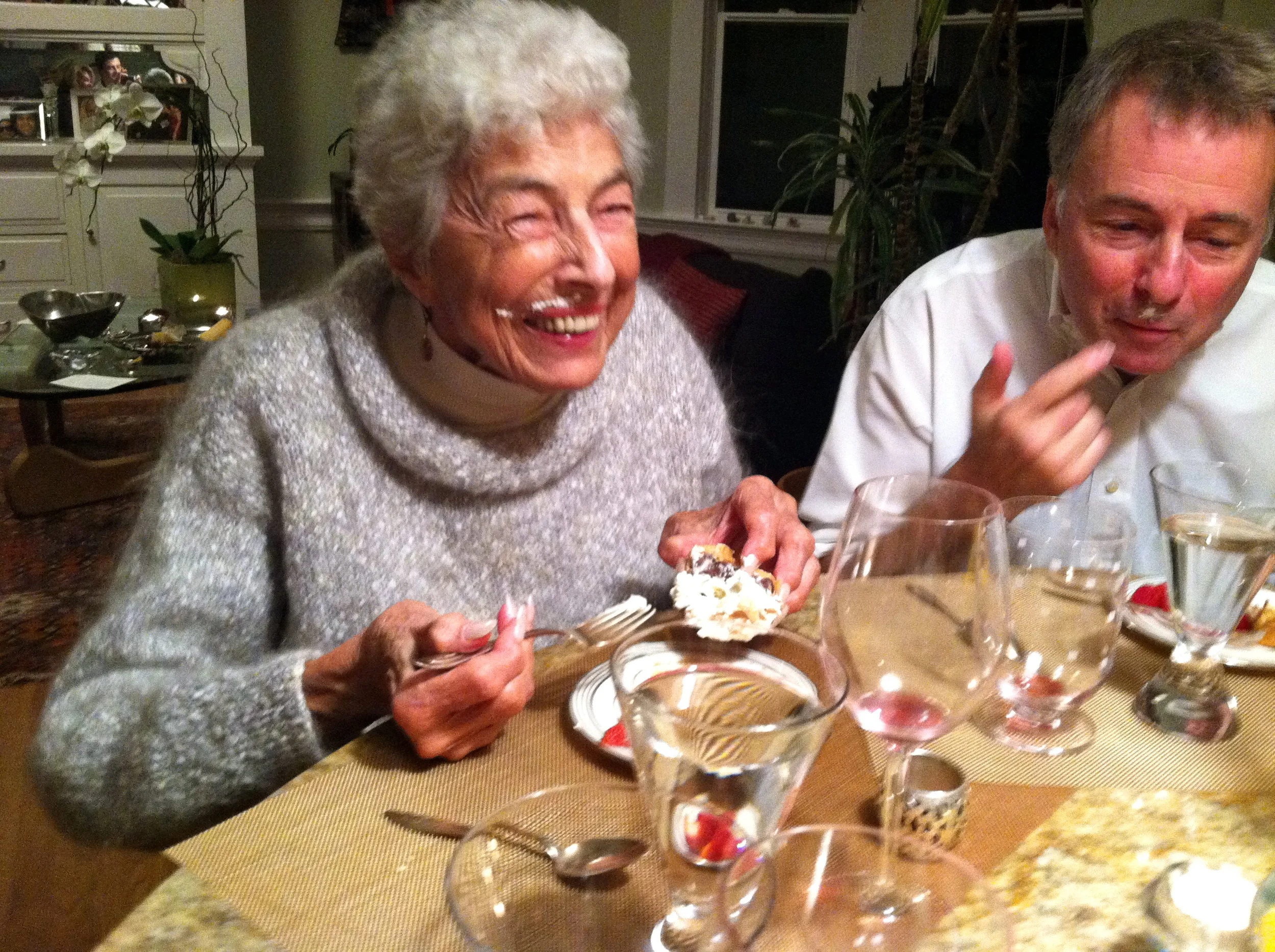
Staying Open is a Choice No Matter the Circumstance
Circumstances don't make the light dim within us. At each threshold, no matter what we face, we have a choice, to stay open or close.
The picture above is of my most favorite aunt, Jeannde. She was one of those very special souls who embraced life with joy, openness, and wonder no matter the circumstances. In the photo, you can see that she’s got whipped cream smeared on her face. She was playful all the way to the end. She had a way of bringing light and laughter wherever she went.
Melissa, my wife, and I got to say goodbye to her a few days before her passing. The evening when we walked into her room, I could feel a profound peace, beauty, and light. At the time, she was in limbo, not quite in this life but not quite in another. She wasn't scared but, in fact, at peace. She was clearly in a lot of bodily discomfort, but her spirit was palpably in total acceptance. We managed to exchange a few powerful words, letting each other know how much we meant to one another; saying, "I love you"; and then, eventually, saying, "Goodbye."
I left that night with a deep peace that reverberated in my heart for weeks afterward. Jeannde showed me that it is possible to continue to stay curious, not only in the twilight years but even up to the moment of death. I always like to tell others that at the ripe age of 87, she was coming to my yoga classes, bending, twisting, and breathing, just like every other 20-something student in the room. I once told her that a few of my students were inspired by her presence in the room. She couldn't understand why. Age meant nothing to her except for the fact that her body was quite a bit less responsive than it had been in her younger years as a dancer.
Jeande taught me that circumstances don't make the light dim within us. At each threshold, no matter what we face, we have a choice, to stay open or close. On her deathbed, on the threshold of the great unknown, in agonizing physical discomfort, she was sharing her heart, expressing her love, and accepting the calling that it was time for her to go. Not only did the circumstances she was in not dim her. They only seemed to add to her luminescence and awe-inspiring capacity to stay in curious and open.

Learning from Adversity
When you’ve been knocked down, there is one question above all else to ask yourself…
Failure. Loss. Hardship. Humiliation. When it hits you, and it will, it’s going to bring you to your knees. Whether it’s your mistake or forces greater than yourself or just dumb luck—something will knock you sideways and it’s going to burn and ache and rip into you.
What’s done will be done. You won’t be able to change what happened or even how you feel about it. Accept these things for what they are: painful facts, as hard as granite, as prickly as a raspberry thicket, but free of meaning except what you yourself give them. Adversity must be faced, dealt with and learned from. How you frame the experience is more important than what happened.
When you’ve been knocked down, there is one question above all else to ask yourself: what can I learn?
Early in his career, Abraham Lincoln was invited to help on a celebrated patent infringement case. Lincoln threw himself into the work and prepared a lengthy brief, but when he showed up for the trial in Cincinnati, hundreds of miles away from his home in Springfield, Illinois, he discovered that a hotshot lawyer Edwin Stanton had been hired instead.
Having made the long trip, Lincoln gamely offered to assist the team at court. Stanton responded by pulling the client aside and whispering, “Why did you bring that damned long armed Ape here … he does not know anything and can do you no good.” Ouch.
Lincoln didn’t pack it in. He stayed for a week to hear the arguments and learn what he could from this legal phenom. According to Ralph Waldo Emerson, Lincoln who was self-educated, was so rapt by Stanton’s lawyering that he determined to immerse himself in further study. He reportedly told Emerson, “For any rough-and-tumble case (and a pretty good one, too), I am enough for any man we have out in that country; but these college-trained men are coming West. They had all the advantages of a life-long training in the law, plenty of time to study and everything, perhaps, to fit them. Soon they will be in Illinois … and when they appear I will be ready.”
While Lincoln found lessons in the experience, it was profoundly humiliating. He stayed at the same hotel as Stanton and the other lawyers, who brushed him off, never inviting him to join them for a meal or the walk to and from court. He expressed to a friend that it was so painful that he hoped never to return to Cincinnati.
It’s a testament to Lincoln’s great resilience and ability to transcend personal humiliation that six years later, as President of the United States during the early days of the Civil War, he offered Stanton the post of war secretary: “the most powerful civilian post within his gift.” For his part, Stanton not only accepted the offer, but came “to respect and love Lincoln more than any person outside his immediate family.” [Source: Team of Rivals, Doris Kearns Goodwin].
The best leaders aren’t infallible; they are resilient. Resilience isn’t an innate quality that some people have and others don’t. It’s a muscle that needs to be worked and strengthened.
It depends on having a mindset that says I am the bamboo tree that bends and adapts to the wind. I am a bird that rides the wind to new vistas. I am the wolf that reads the wind to find my next meal. The tree, bird or wolf may fall or fail, but they—like you—are never failures.
If you have a little voice that is dismissing this idea, listen up. The single most important perspective you can cultivate is that you are a being of growth, always able to learn and repair failure.
The great shackle of the masses is the belief that a person can be a failure. It’s not only untrue, it imprisons you with a need to look successful, deflect blame and hide the truth instead of learning. It interferes with growth and breeds fear rather than safety.
Freedom begins with the belief that you will fail, but you will never be a failure.

How to Connect with People
We mistakenly believe that to create a connection with someone we need to do or say something special or unique, that we have to put on a show or say just the right thing for someone to want to give us the time of day.
Mainly we do not relate to one another. We experience ourselves as separate. I stay in my worldview, and others remain in theirs'. When a connection occurs, it is as if that sense of separation has dissolved. We have transformed from separate objects to being merged as the very same thing. We feel related, in tune, in sync.
We mistakenly believe that to create a connection with someone we need to do or say something special or unique, that we have to put on a show or say just the right thing for someone to want to give us the time of day. Rarely do we consider that, like us, everyone else believes they must say something special to be related to. When we are in conversation, we tend to be in our heads, thinking:
"I wonder what they're thinking about me?"
"If I say or ask x, how will they react?"
"I wonder what I should say next."
"I don't agree with them."
Because we're so caught up in this internal dialogue, we're only enhancing the sense of disconnection. No wonder most of us feel inept and clumsy when it comes to relating.
We have to get out of our heads and into the conversations we're in if we hope to create an authentic connection. We want to widen our field of awareness, to be inclusive of others, and to turn the volume up on our curiosity. When we are curious about another person, our attention naturally shifts toward them and away from the monologue we're having in our mind. It also helps us to listen to their words and what is underneath and behind them. This, in turn, establishes and deepens the connection.
The simple act of giving our full attention creates the initial spark that leads to trust and understanding. If we can grasp and appreciate their point of view, they will tend to drop their defenses. After all, connection results when both people can share their common humanity, quirks and things we struggle with. The more we can hear and see things from their perspective, to respect and validate their experience, the safer they will feel to expose their vulnerabilities. We do not need to concede our point of view to validate their experience. Instead, we have to be willing to stand in their shoes, to grasp how they see and experience the world.
When someone feels understood, accepted and respected, they lose the need to protect themselves. Instead, they feel safe and available to be relatable. The resulting openness creates an opportunity for the meeting of two human beings to occur, warts and all.

How to Reduce Stress
One of the most reliable techniques that can elicit the relaxation response originates from various yoga traditions. Thousands of years ago, yogis recognized that the relaxation response was an integral part of stimulating concentration. As a result, they experimented with a myriad of techniques that elicited deep relaxation.
We all know how important it is to have a calm mind, yet most of us find such a state utterly elusive. Either we are jacked up on adrenaline or feel dull, drained and lethargic. To grasp how to create such a state, we need to learn something about the nervous system. Our autonomic (automatic) nervous system has two modes: sympathetic and parasympathetic.
When confronted with a threat, whether real or imagined, adrenaline courses through our blood, flooding us with the necessary energy to fight or flee. The release of cortisol makes it hard to sit still. We are on high alert, listening for sounds of danger.
In such a state, we misread facial cues, mistaking neutral faces for angry ones. In this sympathetically charged state, the world is an unfriendly and dangerous place. Trusting others is too risky. Long-term sympathetic arousal can lead to permanent, harmful physiological changes.
Just as the body has a mechanism built to help us put out fires, we also have a counterbalancing mechanism that tilts us into a state of wellbeing. The parasympathetic nervous system is responsible for the calm needed to rest-and-digest. Harvard Medical School professor Herbert Benson famously labeled this counteracting state the relaxation response. His research found that routine stimulation of the relaxation response could prevent disease and sometimes even treat it.
One of the most reliable techniques that can elicit the relaxation response originates from various yoga traditions. Thousands of years ago, yogis recognized that the relaxation response was an integral part of stimulating concentration. As a result, they experimented with a myriad of techniques that elicited deep relaxation.
Over the years, various yoga lineages have developed and passed on highly nuanced breathing routines, because they discovered they could stimulate a quality of mind by merely mimicking—and even exaggerating—the quality of breath associated with it.
They noticed, for example, that when the breath was shallow and rapid, that they were agitated, irritable, and unfocused when it was full, slow, deep and rhythmic, they were calm, energized and, at the same time, grounded in the present moment.
It may seem hard to believe that anything special could happen by rhythmical breath. Still, research shows that it has a remarkable ability to balance the two opposing modes of the nervous system, increasing both our capacity to find calm and, at the same time, be energetic.
In a study including 21 soldiers (an active group of 11 and a control group of 10), those who received a one-week training in mindful breathing techniques showed lower anxiety, reduced respiration rates, and fewer PTSD symptoms. This practice is so effective that it works even in the most chronic and intractable cases.
Belly Breathing Exercise
Try this easy, two-minute diaphragm breathing exercise:
1. Find a posture that is both steady and comfortable.
2. Close your eyes.
3. Take a moment to note the quality of your mind.
4. Place one hand on your chest and the other on your belly, just below the navel.
5. As you breathe in, attempt to make the hand on the belly move while keeping the hand on the chest immobile. Doing so will activate the diaphragm. As you exhale, the belly hand will fall.
6. Once you get the hang of expanding the diaphragm, start to regulate your inhale and exhale by inhaling for a count between 3 and 5 seconds. Make sure that:
a. both inhalation and exhalation are equal.
b. you manage to take a full in-breath and out-breath.
c. you do not strain.
7. Once you’ve completed 20 slow, rhythmic belly breaths, compare the quality of your mind to the quality you noted when you began this exercise.

How to Show Empathy
The essential ingredient needed to “show empathy” is our presence. If we want to stand in another’s shoes, we have to be willing to give them our attention wholeheartedly.
Etymologically speaking, empathy means to feel into another’s experience as if it were your own. Real empathy is not performative. You don’t have to “show empathy.” You are biologically wired to be empathetic. The primary thing needed to be empathetic is attention because attention to another’s words, verbal tone, facial expressions and body posture stimulates neurons in the brain that create emotional connectedness.
These neurons are called mirror neurons. When mirror neurons fire, they trick our emotional brains into feeling emotions similar to those of the people around us. When we witness someone speaking about a moving experience, we naturally and unconsciously mimic their facial expressions. This facial mimicry sends signals to our emotional brain, called the limbic brain. The resulting signals prompt us to attune to the person we’re relating to by feeling similar emotion, as well.
So the essential ingredient needed to “show empathy” is our presence. If we want to stand in another’s shoes, we have to be willing to give them our attention wholeheartedly. It can help to look at the eyes, in particular. The eyes are the primary area where we express our emotions. In addition to presence, it can help to learn a few verbal cues that let the other person know you understand them.
Echoing
Occasionally it can help to reflect what you hear them saying. When you reflect, you’re not dissecting, analyzing or reinterpreting the meaning of their words. Instead, you are accurately summarizing or paraphrasing them. You can repeat what they said with the preface, “So what you’re saying is…” Echoing like this lets them know that you hear their words and that you’re with them.
Confirmation
It can be helpful to follow a reflection with the question: “Is that what you were saying?” and/or “Did I miss anything?” You won’t always be accurate when you echo their words. Often, you will miss the essence of what they’re conveying, particularly if you’re in an argument with them or they’re speaking about a delicate subject, either for yourself or them. Asking for confirmation like this can be humbling, but it is the only way for you to know whether they feel that you understand their experience.
Elaboration
You might also ask, “Do you have something more to say?” This question is like a gift. You are granting them the space to unload their burden by inviting them to share all of their thoughts and feelings on a particular topic. This offer allows them to empty the storehouse of emotions, to say all that needs to be said.
Acknowledgement
Once you have listened to someone and fully understood him or her, it can help to acknowledge and appreciate their experience. You can say something like: “I can see why you experience it that way.” Acknowledging in this way shows respect for their point-of-view and experience. The word respect etymologically comes from the Latin roots re-, which means again and –spect, as in spectacle, something that can be seen or viewed. So respect is to look again, to honor or consider the validity of another’s experience.
While I have offered a formula above, empathy isn’t formulaic. It’s natural. It merely requires that we be willing to let go of our point of view, to instead, give them your full attention and to step into their shoes. Likely, it will be the greatest gift you grant to someone. If they can feel and sense you care simply through the quality of your attention, they will feel relieved and safe in the world.

How to Find Yourself
When we know our life purpose, we know the gifts we are here to give. Defining what we are here to contribute helps clarify what and who to focus on and eliminates aimlessness.
Finding Yourself is what the mythologist and author, Joseph Campbell, called “finding your bliss” or your life purpose. Our purpose is that interesting zone where three circles meet in a Venn Diagram.
Circle #1: What you care about.
Circle #2: What you’re good at.
Circle #3: What the world needs.
Purpose blends our passions and abilities with service to others. If we seek fulfillment, everything we do, from the way we make love to our work, must be aligned with our life purpose. When we express our unique talents and use them in the service of others, we lose track of time and create abundance.
When we don’t know what we care about or the gifts we’re here to give, our lives feel hollow, empty and aimless. We feel adrift in the world. If we do something that pays the bills but is disconnected from what we care most about, our work feels like an empty way of spending our time to earn a wage. Life feels flat, uninspired and disconnected from meaning.
Some of us know our purpose and live it, but for most, however, it lies hidden within. Most of us fail to recognize the significance of those occasional moments when we feel “on purpose.” In such moments we feel alive with passion. We’re in the flow. We’re giving our gifts, and they are well-received. Unfortunately, we often let such moments go without paying them much heed. If we gave them the attention they deserved, we’d begin to unravel a thread of purpose that has been with us for as long as we can remember.
If we explore the thread of purpose throughout our lifetime by noting the moments in our lives where we felt connected, in the flow, alive and serving the greater good, we will begin to sense patterns. We will see that, to some degree or another, we have always been fulfilling a kind of purpose. We simply have not been giving it the appreciation it deserves. In a way, we have been sitting on a treasure that we have failed to acknowledge. If we valued our unique contribution, letting them inform our decisions and commitments, our lives and the work we would do in the world would take on a higher meaning.
When we know our life purpose, we know the gifts we are here to give. Defining what we are here to contribute helps clarify what and who to focus on and eliminates aimlessness. We don’t have to keep saying yes to career opportunities that feel like dead-ends and that do not allow us to express our unique talents. Instead, we can stay focused on what we care about and the people and circumstances we are here to affect. Like our heartfelt intentions, knowing our life purpose makes everything so much clearer.
Life Purpose Exercise
One of the best ways to discover your purpose is to explore the following three questions:
What am I passionate about?
What unique gifts and qualities do I possess?
Who or what am I am here to impact positively?
Once you’ve responded to these questions, it can help to ask a few friends the same questions about you:
What do see me being passionate about?
What unique gifts and qualities do I possess?
Who or what do you believe I am here to impact positively?

Burn Out & The Mind-Body Connection
If we can learn to listen to and decipher our body’s interior messages, we can find a way out of the confused and stuck quality burnout shackles us with.
Western science and philosophy have artificially divided the mind and body as if they were two distinct domains. We have almost altogether denied the mind’s influence on the body and vice versa. Think heart attacks, stress-related illnesses. This reductionism didn’t always exist for humans.
Our hunter-gatherer ancestors relied heavily on their senses. They did so to sense where their next meal could be found, where dangers lurked and to identify healing plants. Then ten thousand years ago, human lives shifted dramatically. They began cultivating grains such as wheat and rice. As their lifestyle changed, so did their awareness. In agrarian societies, humans had to become more predictive of the seasons. They had to get more cunning about how they managed their land and resources. The sensitive bodily awareness needed when they were hunter-gatherers weakened and was replaced by a sort of mental deliberation.
While the senses, feeling, and intuition all have their roles to play for the agricultural person, the primary function through which this kind of management is achieved is the thinking function— conceptualizing what needs to be controlled, making plans, convincing others to align themselves with projects, evaluating what worked and didn’t work, keeping track of assets, and so on. You can’t really grow crops in a sustainable way without a lot of thinking and planning. (1)
The distinction between mind and body has become increasingly exaggerated since the industrial revolution. Human body's were regarded as cogs in a big machine supervised by the all-knowing minds of the managers and bosses. And now in the information age, the mind and body are even more divided. We have become like "brains on a stick" trying to take in evermore information. The body is increasingly becoming an obstruction to our addiction to knowing.
We don't want to feel anything. If we do, we need to find a remedy for it. Advertisements promote this mindset with slogans for pain-relieving pills like, "I haven't got time for the pain." So we mask any discomfort we feel with pills, alcohol, pornography, binge-watching series or whatever it is that will dull the pain we feel inside.
Not only can the body not hurt, but it also must look pretty or fit, depending on our gender orientation. We then starve ourselves or over-exercise to fit some external images we believe we need to achieve. When we don't, we seek out plastic surgeons. We have come to regard the body as an object that needs to fit into some abstract form. When it does not, we wage war on it and as a result, on ourselves.
How the Body Speaks To Us
This long term war takes a toll on our lives. The more we objectify the body, the more disconnected we feel from ourselves. As we ignore and stop heeding its messages, we can’t help but sense a dullness, a malaise alternating with a vague and sometimes overwhelming sense of anxiety. The more we ignore what we feel, the more the body will try to break through, to scream at us to let us know that it won’t be ignored.
Burnout is on the rise. The corporations we work for hold us to dehumanizing metrics. In the same way that we treat our bodies as objects, the corporations we work for treat us like objects. Their hunger from profitability demands we perform at a pace that is beyond our capacity.
When I began working with Bob, he was experiencing panic that kept him up throughout the night. He was on a mission, not only to be financially successful but to do good things for our environment, and he worked tirelessly to achieve his goals and aspirations. He’d been using sedatives to get to bed and amphetamines to keep himself focused throughout the day. Like many hard-driving, young professionals these days, Bob was on his way to burning out. His doctor prescribed a cocktail that initially worked, but by the time he had reached out to work with me, it had stopped working.
The body can withstand this demand for only so long. It demands a modicum of rest to repair itself, but because we’ve learned to ignore its signals, it eventually gives way. We may initially sense fatigue. We might mask that fatigue with caffeine. One cup of coffee in the morning gives way to another cup around the 3 PM dip and maybe another cup of coffee before coming home so that we can stay present enough with the kids.
The added caffeine so late in the day makes it hard to fall asleep, so we start taking a sleeping pill. And because the sleeping pill only sedates us, we don’t wake up feeling rested. So the first cup of coffee is replaced by the double-shot of espresso. And because the body gets habituated to stimulants, that double-shot will have to give way to something stronger. The same is true of that sleeping pill.
At some point, the body cannot sustain what we are demanding of it, so it gives way. We might experience one or more of the following symptoms associated with burnout: worthlessness, helplessness, exhaustion, irritability, pessimism, apathy, frustration, disillusionment, difficulty focusing, sleeplessness, abdominal pain, etc. And then we wonder why we aren’t as effective as we used to be.
It’s because we have created a false expectation of what the body “should be able to sustain.” We should be able to make poor food choices, to barely exercise, to give ourselves no time for rest and repair, to not need time for solitude or reflection. We should dictate what our body feels and not the other way around.
How We Listen to the Body
Even though we may not always be able to decipher everything it says or remedy what ails us, we can learn to listen to it. It's speaking to us all the time. To create the "mind-body connection," we have to tune in, to bring a curious and open quality of awareness to what we feel.For most of us, that means descending from our head downward to the rest of our bodies.
Many of us identify ourselves as this entity somewhere behind the eyes, and we have this appendage down below us called “my body.” The body is just a thing, a slab of meat and bones, not who we are. As I said above, that’s a natural response to living in and working in a time in history where our cognition is highly valued over our manual dexterity. For most of us, that means dropping our attention downward to include the rest of our bodies. If we are honest with ourselves, most of us identify as this entity that resides somewhere behind the eyes, and we have this appendage down below us.
If we let ourselves feel what's happening in our bodies, we can sense a plethora of information in the form of feelings and sensations: tingling in the fingers, rumblings in the gut, pressure in the chest, coldness in the toes, a thrum of excitement throughout the body. By attuning to these felt experiences, we begin to intuit or sense another quality of knowing than the one we are used to.
When we hangout only in our heads, we listen only to the surface layer of the mind, its wants and desires, its reactions and frustrations. By hanging out at this layer of the mind, we only see the surface layer of things. It’s like seeing broken reflections on the surface of choppy water. We see all sorts of problems and confusions, but we don’t understand or can’t make sense of how apparently disparate frustrating phenomena fit into a cohesive whole. When we hang out in our heads, we only see problems needing to be fixed. From this point of view, the challenges we see appear like a great chaotic mess. When we sense from the body, we access a deeper layer of knowing. Going back to the case study above:
I taught Bob how to contact and find language for his inner feelings by dropping down into the body. By doing so, he could access a kind of knowledge associated with the struggles he was feeling about the stress and anxiety keeping him up at night. It wasn't a pleasant experience for him, but what fascinated him was that the feelings he was contacting had been with him since he was a teenager.
When he was seventeen years old, he had reached out to his father to share a happy moment. The high school basketball team he'd captained had become state champions. Instead of his father rejoicing in his son's success, Bob's dad shot back, "That's 'child's play." His father's put down made him feel that his accomplishment was not good enough to win his father's respect, something he deeply longed for.
From that point on, Bob felt a searing almost maniacal drive to be worthy of his dad's admiration. The pain of never being enough in his father's eyes compelled him to seek achievements where he overrode his body's limits. For him to find a new relationship with his work and sleep, he would have to learn to heal his need for his father's approval.
If we can penetrate through the apparent reality to a sensual, more direct way of knowing, we can begin to weave together a more cohesive grasp of what’s taking place. We can then make choices that heal and support our well-being.
Why What We Feel Matters So Much
In 1997 neuroscientist Joseph LeDoux discovered that all data entering the brain from outside had two neural pathways, an upper and a lower pathway. The lower pathway was shorter and more primitive than the upper pathway. In other words, it took less time for data entering the lower pathway than the upper one. That data first went to less evolved structures in the brain, structures that mount fight-or-flight reactions. By the time those brain structures kicked into gear, the data would enter structures with higher cognitive functioning. These structures enable us to orchestrate tailored responses based on our goals.
What makes LeDoux’s discoveries significant is that we feel or sense things before we even comprehend them. Feelings precede thoughts. That’s why we reflexively jump first and then afterward distinguish whether what we are avoiding is a snake or a stick. In spite of the fact that this is the case, culturally speaking we have given preeminence to our thinking nature and have disregarded our feeling or sensing nature.
Corporations, generally speaking, don’t hold feelings in high regard, and yet feelings are what motivate us. It’s not thoughts or concepts that cause us to move mountains. It’s feelings like exhilaration, inspiration, excitement, and interest that motivate us. Even feelings like regret, guilt and fear can be great motivators. The problem with these latter feelings is that they’re fuel is short-lived compared to the former. We can only run on fear for so long. Eventually, we fatigue. Nevertheless, the more our culture glorifies higher thinking centers of the head and either disregards or condemns the feeling experience’re going to have to learn how to motivate the heart and gut in addition to the head.
What the Body Knows
In some ways, the notion of the heart and gut are metaphors. We all connect the heart to poetic ideas of love and connection and the gut to instinct. Biologically speaking, these are not merely artistic notions. More than a simple pump for blood, the heart is a brain unto itself. It has somewhere between 40,000 and 120,000 neurons. The heart sends more information to the brain than the brain sends to the heart. Like the brain, the heart is neuroplastic; it can grow and change. It continues to create new neuronal connections as our emotional and empathetic capacities continue to expand.
We now have scientific evidence that the anatomical heart sends us emotional and intuitive signals to help govern our lives. It does so through several different hormones, the primary one being oxytocin—the hormone associated with labor and maternal bonding, and is also involved in relational bonding, emotion, passion and values. The heart produces equal amounts of this hormone as the brain itself.
Our gut is known as the second brain. It consists of more than 500 million neurons, about the same amount as in a cat's brain. Our bowel produces over 95% of our total serotonin, the neurotransmitter that regulates our feelings of happiness. The gut is quite distinct from the thinking mind in that it speaks in declarative tones via sensations. It says things like, "Yuck," "Yum," "Ow!" "Mmm," "No way!" "Yes!" and "No!" Unlike the thinking mind, the mind in our gut doesn't second-guess. It merely calls out what it senses.
Complementary medicine advocate Deepak Chopra used to tell the story of an interview he had with the late co-founder of Sony Corporation, Masaru Ibuka, who liked to "swallow" a deal before he signed it. If Ibuka had a vital choice to make, he would do his due diligence: consult with key people, review market data and research sales reports. But he didn't stop there.
He’d have his assistant prepare a Japanese tea ceremony, which is actually a type of meditation. Once the tea was prepared, he’d hold a “yes” or “no” question” in his mind. He would then take a sip of tea and listen, carefully observing how his body responded to how the tea felt in the stomach. If it felt good, he interpreted that as a “yes;” if it didn’t, it was a “no.”
“I trust my gut and I know how it works,” he said. “My mind is not that smart, but my body is.”
As a culture, we have attempted to disconnect the mind and the body, but they are intricately connected. If the body’s subtle power is tapped, it can become a sensitive antenna for tuning in, whether into others to motivate and inward as a way to generate creative breakthroughs. The body has the potential to be a master teacher. If we listen, not only can we learn to be healthier, more vital, more balanced, but also wiser, more compassionate and more relatable.
Centered Body Centered Mind
One way we can strengthen the mind-body connection is to bring attention to the way we stand. By standing erectly, we stimulate hormones, such as testosterone, that give us a sense of confidence. This confidence is conveyed throughout all of our interactions and helps us feel more aligned in our head, heart and gut.
Plenty of us, however, stand with our heads jutted forward. This posture puts our heads in a primary position and, at the same time, closes the heart's wisdom, putting us out of touch with our ability to connect and to be connectable. Some of us stand weakly. Metaphorically speaking, we don't know what we stand for. We're unwilling to stand up for what's important. Many of us stand in an unbalanced way. We either stand too far forward or we stand too far back. By standing back, we are seen and, in fact, experience ourselves as timid or holding back in some way.
As mentioned earlier, many of us believe that the center of our gravity lies somewhere behind the eyes when, in fact, biomechanically speaking, the center of our gravity is about two to three inches below the navel. Yogis and martial artists have known this fact for thousands of years. They cultivate balanced and centered postures and movements, not for the sole purpose of being able to either defend themselves, throw their opponents or twist into acrobatic positions. They recognize that by cultivating equipoise in their bodies that it translates into mental, interpersonal and spiritual equipoise. Through practices that strengthen the mind-body connection, the body becomes the metaphor for how the practitioner thinks and acts in the world. All subsequent actions in the world are influenced by focusing on harmonious centering in the body. When through years of practice, equipoise becomes our natural state, we can easily sense what decisions will throw us off center, how an interaction needs to go in order to achieve our goals and when not to insert ourselves because to do so would needlessly sap our energy.
An embodied approach to life is intuitive rather than proscribed. The truth of the matter is that there are not enough tips and tricks that can get any of us through the crises and catastrophes we face. All prescriptions tend to come up short, and when they do or when they eventually fail us, we tend to revert to what we know. But if we cultivate our mind-body connection, if we learn to listen and sense when we are off-center, we can equally sense what will bring us back to our center. The expert is not outside of ourselves, it is with us always, if only we will tune in.
Partner Exercise
Have your partner stand behind you.
Stand with your feet hips width apart.
Ask your partner to gently push you forward two separate times.
In the first time, place your attention behind your eyes, keeping all your awareness in your head.
On the second time, place you awareness 2-3 inches below your navel.
Notice how your stability shifted as your awareness moved from your head to your biomechanical center.
Footnote:
(1) Ray, Reginald. Touching Enlightenment: Finding Realization in the Body. Sounds True. Boulder, CO. 2008

Spirituality That Includes Darkness
An honest approach to spirituality requires that nothing is left out, the good, the bad and the ugly. At the same time, it necessitates that we stay at the razors edge of knowing such that we believed yesterday is no longer valid today.
Life is a great mystery. In spite of the fact that people and religions claim to know its meaning or purpose, if we’re honest, each of us cannot help but admit that its meaning or even the reason for life is unknown to us. So much of it appears and can feel like a chaotic mess and can easily be regarded as a random series of failures, successes, joys and sorrows. Each of us both witnesses and experiences tragedy, loss, calamity and heartbreak, occurrences that appear so completely unfair and random that they blow apart our conceptual reality and the belief systems we hold onto as a way to make sense of life. In short, anyone who gets born cannot help but see that life, while filled with wonder and delight, is no cake walk.
So much shit happens, that it could so easily be seen as unfair, unjust, cruel and random. Deceitful people run our governments. Poor and innocents are stolen from. Minorities are incarcerated when they have not even committed the crimes. One of the primary contributors to the darkness we see in the world are, in fact, our corporations. While these entities are filled with individuals who care a great deal about our planet and might have strong moral compasses, corporations, nevertheless, function almost as sociopathic entities whose primary focus is doing whatever it takes—even if it leads to terrible consequences to humans, animals and the environment—to ensure that the stock price continues to soar and that investors profit.
Each of us is filled with greed, darkness, and yet mostly we refuse to acknowledge this. Most of us fluctuate between denying the darkness inside or becoming so overwhelmed by it, that it makes us want to give up entirely. Our darkness and the darkness we see in the world and our associated suffering can make the very idea of spirit and spirituality a joke. Each of us cannot help but wonder how a God or orderly universe could create so much suffering? What sort of God would sit by as innocent children were caged for the color of their skin? What cruel God could possibly allow individuals to be wracked with illness from contaminated water? What sort of loving God could oversee the environmental decay we find ourselves in today?
Spirituality that denies the darkness is not actually spirituality. Instead, it is a sophisticated form of denial of the darkness. New Age beliefs, like the law of attraction, are a classic form of spiritual denial that forward the shortsighted belief that everything we want can be “attracted” into our lives. All we need to do is repeatedly think about it and “stay positive,” believing we can have what we want.
What are we to believe, then, when unwanted things happen, like disease? Is it then not our fault? Did we not give enough time to imagining our lean, sexually attractive bodies glowing with light? Or was the light we imagined the wrong color? Were we not positive enough? Or even worse, did we attract the illness by virtue of our innately negative thought patterns? This belief compels us to brush-off or ignore the obvious abhorrent nature of a situation or a person.
Our disgust and hate, though, are not merely qualities to be denied. They are, instead, innate capacities that enable us to discriminate true from false, right from wrong, and good from bad. Anyone with a slightly discriminating eye cannot help but see this denial afoot in all major religions. Just look at Spanish colonization throughout the Americas. Columbus and his followers believed that these lands were one vast kingdom of the devil.
Their church embraced all their deeds. The rape of children, the violation of the earth, the destruction of all that was beautiful could be condoned by the halo of the faith. Men who had sex as if relieving themselves declared all native women to be whores, and branded the faces of children while the Pope debated whether or not they were human beings. Priests who exhaled disease declared pestilence to be the will of God. In their wake they left death. Three million Arawakans died between 1494 and 1508. Within 150 years of Columbus the aboriginal population of 70 million would be reduced to 3.5 million. In the Southern Andes of Bolivia, on a mountain of silver once sacred to the Inca, an average of 75 Indians were to die every day for over 300 years. (1)
While we tend to think that Buddhism is a peaceful religion, just look at the the 2016 Rohingya persecution in Myanmar where Buddhist armed forces have been accused of ethnic cleansing, genocide, gang rapes, and infanticide of this Muslim minority.
How do we make sense of the suffering we experience and the suffering we see in the world? Is there a world order that includes not just the light but the dark as well? These are the very questions that we must contend with in order to face the question of spirituality with honesty. We cannot cordon off some aspects of life and say, “That just doesn’t fit into our concept of God, so it doesn’t exist.” We have to be brave enough to contend with the whole thing, light and dark, love and fear, greed and generosity.
The Absence of Meaning
Otherwise, we might as well agree with the skeptics that the whole thing called life is random. For many, this is the only way to make sense of the confusing mess that life can sometimes be. Yet without spirit, without a sense of principles or meaning, we are left with no other choice but to take what we can in this lifetime, to consume, to steal, to rape. After all, if the whole thing is random, if there is no order to this thing called life, what’s the point of upholding values like honor, kindness, charity, or compassion? From the perspective of a world without spirit or meaning, there is no purpose or greater meaning.
Without that meaning, we are no different than single-celled amoeba, tubes that consume, excrete, procreate and die. Nothing more. We, therefore, might as well consume as much as we can, to take what is ours' and not worry one bit about how that affects those around us. We can say, “Who cares if my choices and actions negatively impact the poor and innocent? Fuck them. I can do what I want.” We see plenty of individuals on the world stage with just that point of view, including our so-called world leaders.
Intuitive Knowing versus Scientific Knowing
For many a dog-eat-dog worldview is just the way it is, and for them the very concept of spirituality is lost on them, unless, of course, they embrace a spirituality of denial that justifies their cruel behavior. But for many of us, such a worldview denies an intuitive or innate sense that this thing called life is not random. Many of us sense, if only in moments, that there is a kind of logic to life that while at moments is graspable, at other moments is far beyond our capacity to understand.
In other words, life is a great mystery. What makes it mysterious are its dual qualities of being both coherent or intelligible and, at the same time ineffable or beyond our capacity to grasp. Our cultural drive toward a scientific worldview has forced all that cannot be seen or known into the categories of superstition, untruth, wives tales, or magical thinking. In other words, if we cannot see it in a microscope or science hasn’t identified it yet, it doesn’t exist. In our drive to understand and make sense of the world around us, we cling to only one way of knowing, that which is scientifically verifiable, and deny or suppress other forms of knowing, in particular, our innate knowing or our intuitive sense.
This latter form of perception has been given short shrift. Since the scientific revolution, we have overestimated the value of the intellect, which can only analyze, consider, debate, and understand. In turn, we have completely devalued our bodily sense of truth, our innate sense of grasping and knowing.
This innate quality of knowing was the very essence of our hunter-gather ancestors’ religion. Hunter-gathers still living today in remote parts of the world depend on their external senses along with their inner felt experience as a way of knowing the world around them. In fact, their very survival is predicated on the dual capacities of sensing and feeling. Without it, they run the risk of getting mauled by a cougar or starving to death.
As our ancestors shifted from a hunter-gatherer life to a more agrarian one, they relied less on their ability to sense the world around them for their survival. Instead, they needed to keep track of the amount of grain in their granaries, to understand the seasons, when they would harvest and when they would plant seeds. They needed to forge agreements with other farmers or landholders to share access to water.
Humans shifted from needing to sense the world around them to needing to understand the world around them. The world shifted from something directly known to something conceptualized. This approach to life became even stronger in the industrial revolution and now and especially, in the information age. Slowly and imperceptibly, humans have lost touch with or even value their direct experience. If we sense the truth of something, we have little trust in it unless our intuitive knowing is backed by science.
Iterative Meaning Making
In spite of the fact that we place such little value in this intuitive knowing, many of us cannot help sensing a greater meaning or purpose to this thing called “my life.” We innately sense that our lives matter, that our suffering is not just a random mistake, a glitch in our DNA, a lack of serotonin, a random fluke of nature or a broken and prejudice legal system gone awry. These facts of life are undeniable. The world is filled with a lack of justice, and yet many of us, if only momentarily, experience an intuitive understanding of an orderliness in the world and of our lives in which something intuitively makes sense.
That intuition, that sense does not always hold up to scientific scrutiny, nor can we reduce it to a simple formula or story. Mostly what we come up with intuitively are hypotheses, best guesses until more knowledge or experience comes along. In other words, intuitive knowing is iterative. We sense something, interpret it to the best of our ability only to realize that our initial interpretation was partial or incomplete. If we remain honest with ourselves, we stay present with the process of sensing from moment-to-moment because whatever we sensed and interpreted a moment ago has surely already changed.
In other words, an honest approach to spirituality remains open and flexible. It’s actually a moment-to-moment encounter with life. It’s not fixed nor is it formulaic. It doesn’t deny the intellect or analytical knowing but it also doesn’t deny what we sense in our hearts and guts. It doesn’t leave out the darkness we inevitably confront in ourselves or the darkness we see in the world. It isn’t reductive either. We cannot reduce the great mystery of life to Four Noble Truths or Ten Commandments. While those instructions may be helpful, to rely exclusively on them is to stay stuck in concepts rather than confronting the direct, unmediated experience of life.
Contextualization
Spirituality, then might be thought of as the creative attempt to explore life by making sense of it. It is the innate drive within each of us to make our lives matter and to give them purpose and meaning. After all so much of what we both experience and perceive around us can so easily be passed off as cruel, unjust, and random. Nevertheless, we humans can make meaning of the most demeaning and inhuman experiences; in fact, when faced with such experiences, our ability to survive and thrive depends on this capacity. However, making sense of it in such a way that either denies the darkness, passes it off simply as a test of survival of the fittest, or whittle it down to a five-easy-step formula is overly simplistic.
An honest approach to spirituality requires that nothing is left out, the good, the bad and the ugly. At the same time, it necessitates that we stay at the razors edge of knowing such that we believed yesterday is no longer valid today. As Holocaust survivor, psychiatrist and author, Victor Frankl aptly commented about the horrors he saw and experienced in the concentration camps:
We had to learn ourselves and, furthermore, we had to teach the despairing men, that it did not really matter what we expected from life, but rather what life expected from us. (2)
Most importantly spirituality creates an order to our lives. It gives context to the apparent random nature of our experience. The words context comes from the Latin roots con- meaning with or together and -text come from the same root as textile. Context weaves apparently arbitrary interactions and experiences into a greater whole. When we contextualize our experience, we do so in order to create meaning or see patterns in what appears to be random squiggles.
The act of weaving a greater meaning into apparent accidental nature of of our lives gives them order. At TED2018, psychiatrist Essam Daod tells the story of Omar, a five year old Syrian refugee who arrived on the island of Lesbos on a rubber boat:
Crying, frightened, unable to understand what's happening to him, he was right on the verge of developing a new trauma. I knew right away that this was a golden hour, a short period of time in which I could change his story, I could change the story that he would tell himself for the rest of his life…
Omar looked at me with scared, tearful eyes and said, "What is this?" as he pointed out to the police helicopter hovering above us.
"It's a helicopter! It's here to photograph you with big cameras, because only the great and the powerful heroes, like you, Omar, can cross the sea."
Omar looked at me, stopped crying and asked me, "I'm a hero?"
Without this reframing, Omar likely would view this moment simply as an overwhelmingly frightening one. By contextualizing it as a “hero’s journey,” Daod is weaving meaning for this small, frightened boy. He’s giving dignity to the indignity he has to endure.
We are not, as the saying goes, “human beings having spiritual experiences,” but, instead, “spiritual beings having human experiences.” This perspective juxtaposes our regular, commonplace view of our lives. Instead of seeing them as a series of random mundane experiences interspersed occasionally with transcendence, we see the potential within each experience—even the darkness we face—as opportunities to grow and evolve, to fulfill an unseen potential inherent in each one of us. Sensing and touching this potential is foundational to any true experience of spirituality.
Footnotes
(1) Davis, Wade. One River. Simon & Schuster. New York. 1996. Print
(2) Man's Search for Meaning, Frankl, V., Beacon Press, 2006. p. 77.

How to Be Mentally and Emotionally Strong
Developing emotional strength requires then that we be willing to let go of what we think should or shouldn’t happen, what’s right or wrong, what’s good or bad. Instead, we bring a quality of openness, receptivity, even a welcoming to whatever it is that we experience, even if it is initially unpleasant.
Both individually and collectively, we are facing a moment of great disillusionment. We are losing faith in our institutions. Many of us feel more angst about our futures and the very future of our planet. The easy paths are either to 1) ignore the chaos we see around us, 2) to let the pain of disenchantment feed our anger and fear or 3) fall into a pit of despair at the state of things.
Our anxiety at the state of things might be the thing we need to wake up. Rather than regarding this collective crisis as one big mistake, we might also consider it the perfect curriculum required for each of us to grow and evolve into the human beings we need to be. As the spiritual teacher and author, A.H. Almaas, writes:
The problematic situations in your life are not chance or haphazard. They are specifically yours, designed specifically for you by a part of you that…doesn’t want you to lose the chance. It will go to extreme measures to wake you up, and it will make you suffer greatly if you don't listen. What else can it do? This is its purpose. (1)
Everything we touch and see, including the things that cause our suffering, has within it the potential to wake us up. Developing emotional strength requires then that we be willing to let go of what we think should or shouldn’t happen, what’s right or wrong, what’s good or bad. Instead, we bring a quality of openness, receptivity, even a welcoming to whatever it is that we experience, even if it is initially unpleasant.
Instead of resisting or ignoring this unpleasantness, we want to learn to turn toward it, to face it. Welcoming unpleasant feelings is both counterintuitive and daunting, especially if we have spent a lifetime turning away. Most of us develop a guarding around our hearts to protect us from pain or discomfort. We have become addicition to distractions of various forms, like compulsively checking social media, ingesting intoxicants or binge-watching the latest series on Netflix.
If we can let our hearts feel again, we might initially confront overwhelming pain, but if we can learn to stay centered and non-reactive, the initial discomfort will eventually abate. If we can learn to ride our emotions all the way to shore, we begin to discover an inextinguishable strength within ourselves. In mindfulness, this strength is called boddhichitta. “Chitta” is heart-mind. “Bodhi” is the same root as “buddha.” It means awakened, enlightened or completely open. Our bodhichitta is a completely open heart and mind. As Pema Chodron puts it:
Bodhichitta is our heart—our wounded, softened heart. Right down there in the thick of things, we discover the love that will not die. This love is bodhichitta. It is gentle and warm; it is clear and sharp; it is open and spacious. The awakened heart of bodhichitta is the basic goodness of all beings. (2)
Few of us access this fountain of strength on our own. We need support and guidance. Many of us mistakenly believe that asking for help is a sign of weakness. It is, instead, a sign that the stakes have just gotten higher, and the current set of tools we have aren’t quite up to snuff.
The good news is that there are trustworthy people out there to help teach us how to find our unique way forward. They come in the form of guides, teachers, therapists, coaches, doctors, healers, books, teachings, practices, philosophies, medicines etc. For many of us, the plethora of choices can be overwhelming.
The critical thing to look for is any non-dogmatic teaching. It would help if you were allowed to experiment with what you learn rather than taking it on faith. It would be best if you didn’t have to follow tradition for tradition’s sake but through your own experimentation. If you discover that the practices and teachings both make sense and work for you, you’ve found your path to developing inner strength.
Footnotes
(1) Almaas, A.H. Diamond Heart Book One: Elements of the Real Man. Shamabala Boulder. 2000.
(2) Chodron, Pema. Comfortable with Uncertainty: 108 Teachings on Cultivating Fearlessness and Compassion. Boston, MA. Shambhala. Kindle Edition. 2008.

A Powerful Antidote to the Inner Critic
There is a powerful antidote to the Inner Critic, but you will need to learn how to cultivate it: self-compassion. The more warmth you can give yourself, the less the Inner Critic needs to take over.
There is a powerful antidote to the Inner Critic, but you will need to learn how to cultivate it: self-compassion.
Compassion means “to suffer with.” When you see a small child break an arm, you naturally feel moved to offer kindness and comfort. You may not be able to stop the pain, but just being there to hold a hand and say reassuring things can soothe some of the suffering. Your presence has a calming and encouraging effect.
Both giving and receiving kindness releases oxytocin, a.k.a. “the love hormone,” which makes us feel warm, safe and connected. It’s an incredibly powerful hormone that gives mothers overwhelming love for their infants even after the pain of childbirth.
Self-compassion is about keeping good company with yourself when you are suffering. If you can learn to flood your brain with oxytocin, your emotional pain—acute, chronic and deeply buried traumas—can heal and shift. The more warmth you can give yourself, the less the Inner Critic needs to take over.
Few of us were taught to consider relating to ourselves at all, much less compassionately. You may believe that compassion needs to come from others, not yourself. This idea is due in part to the Inner Critic’s fear that if you are too kind to yourself, you will succumb to your weaknesses.
But self-compassion isn’t self-pity or self-indulgence. It’s not getting wound so tight around your problems that you lose sight that others are suffering, too. It’s not chowing down a pint of ice cream. It’s not giving yourself permission to lash out at others or letting yourself off the hook.
Compassion isn’t something that you need to earn for being good enough. The child with a broken arm didn’t do anything to deserve your compassion. You deserve to feel compassion for yourself because all human beings deserve compassion. You are a child of the sun. It shines on you with as much warmth as it shines on every other living thing. And why shouldn’t it?
Self-compassion is your antidote that can be applied no matter what you’ve done or haven’t done. It will heal the knotty parts of yourself that have never been adequately acknowledged or cared for. Demanding that these parts shut up, stop whining or get it together doesn’t make them go away, does it? Self-compassion has a way of melting the knots.
Tool: Loving-kindness Meditation
A kind and loving approach to self may be antithetical to the way you have been raised. If that’s the case, it’s helpful to develop a practice of self-compassion. I’m partial to Loving-Kindness (a.k.a. Metta) Meditation. It comes from the Mindfulness tradition and is designed to develop warm feelings for ourselves and all beings.
1. Loving-Kindness to Yourself
With an open, loving heart, breathe gently, and recite the following traditional phrases directed toward your own well-being.
May you be happy.
May you be safe
May you be well
May you be free from suffering.
For most of us, offering ourselves love is foreign. Be aware that this may feel awkward or irritating at first. If that happens, it’s especially important to be patient and kind with yourself. It may help to visualize yourself as a young child.
Alternatively, you might find it easier to bring to mind a friend or loved one—living or non-living—or an animal that loves you as you are. Someone who wants you to be happy, who when you think of them brings a sense of warmth to your heart. Envision this being sending you your good wishes in the four phrases above.
When you receive loving-kindness from another, it will fill you with positive feelings of abundance and goodwill. It can help to repeat the phrases multiple times, paying particular attention to the intention behind them.
2. Loving-Kindness to Those You Care About.
After you connect to the preciousness of being loved unconditionally, you take this overflowing abundance of love and goodwill and direct your attention to a person or animal beyond yourself, a friend, a loved one and someone in need. Holding them in your mind’s eye, you send the same wishes:
May you be happy.
May you be safe
May you be well
May you be free from suffering.
3. Loving-Kindness to Toward All Beings
Often at this point in the meditation you will begin to feel a kind of opening of the heart, a sense of inclusivity. In this step, you expand your loving-kindness to those in distant places that you may never come in contact with.
We might imagine everyone in your city, state or country. You might include everyone in the world or in a particular place.
May you be happy.
May you be safe
May you be well
May you be free from suffering.
You might also bring to mind someone who could really use loving-kindness, such as an infant in a far away land just being born, someone dying, or someone caring for a sick parent saying internally to ourselves.
You might also include non-humans, too. You might visualize all animals and plants, a particular animal or even a single celled amoeba, bacteria or virus.

My Favorite Books: A Collection of Spiritual Classics and Modern Wisdom
I’ve come across so many books, so many teachers and teachings over the years, but only a few fit into the category of friend and teacher. Here I share 12 of the most significant books to me. I dare say that I love these authors. It is my sincere hope that you do, too.
I set out to share some books that I've found valuable and important for a soulful journey. The books I return to and recommend often. But as I began to write, I realized that what I was bringing together and sharing were more than books: they were friends and teachers that have walked the path with me.
Each of these books is written by someone who touched me at a critical juncture on the path. Herman Hesse’s Siddhartha, for example, was one of the first books I ever read about spirituality. Pema Chodron’s When Things Fall Apart: Heart Advice for Difficult Times was my companion when I was facing the pain of unrequited love. Ram Dass’ talks helped me transition back to university life after I took a year off to explore yoga in India.
While I don’t know any of these authors personally, I feel an intimacy with them and their words. I think that’s what makes these books so significant. I dare say that I love these authors. It is my sincere hope that you do, too.
Mastery: The Key to Success and Long-Term Fulfillment by George Leonard
This is a quick, easy read that taught me a simple truth about the soul’s journey, or indeed any journey toward mastery for that matter. He calls it hanging out in the plateau. Each of us experiences breakthroughs in a flash, so we tend to think that there’s some quick, magic trick we need to learn or fault in our thinking when we feel stuck or in a rut.
We forget that most breakthroughs happen after spending periods of time feeling plateaued. Instead of considering the plateau as a fault or a misstep, we might, instead, consider it the place where the breakthrough can come. In other words, it takes repetitively practicing the same thing over and over again without any apparent progress before something mysterious happens.
All of the sudden we can do or be something or someone we never thought was possible. Plateaus, then are something to appreciate as inevitable and necessary parts of the journey.

Patanjali's Yoga Sutras translated by Chip Hartranft
The Yoga-Sutra of Patanjali: A New Translation with Commentary by Chip Hartranft
I love the plethora of spiritual practices and philosophies that I see all around these days. One thing I wonder about is how all of these newfangled perspectives hold up over a lifetime. That’s probably why I’ve been drawn to the Buddhist and Yoga Traditions.
If you think about it, they’ve been around forever. It’s not accidental that they’ve lasted the test of time. They work. They offer practical instruction that is applicable and useful, no matter what period in history. That’s why they’re part of the cannon known as the perennial philosophy. They work at any time, anywhere and with anyone.
Being a lifelong student of both traditions, particularly Yoga, I’m drawn to this translation of Patanjali’s Sutras. The translator, Chip Hartranft did something no other translator has yet done. He’s shown how the author of the Yoga Sutras, Patanjali, was influenced by Buddhism.
Most translations spin the Sutras into a conversation about God, Like Christopher’s Isherwood’s translation, How to Know God: The Yoga Aphorisms of Patanjali. While Patanjali included faith as a path to enlightenment, he also included many others. In particular, he focused on sadhana or the practice of stilling the mind. This process of quieting down leads to the direct, practical experience of pure awareness, or as the Buddha would call it, our Buddha nature.

A General Theory of Love by Thomas Lewis, Fari Amini and Richard Lannon
A General Theory of Love by Thomas Lewis, Fari Amini and Richard Lannon
I went to grammar school and high school with one of the author’s daughters. This book is beautifully written, more like a love letter than a science book about the human brain and its relationship to love and intimacy. That’s not to say that science is excluded.
On the contrary, the authors, three psychiatrists from Stanford and UCSF share a lot about human development, Attachment Theory and how psychotherapy works. It’s been a few years since I've read it, but one concept that has stuck with me (and sticks with most of my friends who have read it) is limbic resonance.
It’s this idea that portions of our brain link with one another when we experience intimacy. When we tune in to one another, we regulate not just one another's emotions, but nervous systems and endocrine systems, too.
This is a scientific way of saying that biologically we need one another for our very survival, and that our brains and bodies are not designed for the kind of loneliness and isolation we experience in post-modern societies. We’re designed to share and care, to love and be loved. Without those vital things, we suffer.

A Path with Heart by Jack Kornfield
A Path with Heart: A Guide Through the Perils and Promises of Spiritual Life by Jack Kornfield
Jack Kornfield is a national treasure. No, he’s not recognized as such outside of the mindfulness tradition, but he should be.
He went to Thailand to study meditation in a forest monastery long before anyone else did, sometime around 1978. He had to learn Thai, shave his head, take up the robes and be subjected to quite a harsh path under his teacher, Ajahn Chah. Interesting enough, what came of that has been nothing but generosity and sweetness.
He co-founded arguably two of the most important Theravada meditation centers in the U.S., the Insight Meditation Society in Barry, MA and Spirit Rock in Marin County, CA. He also wrote one of the sweetest books on Buddhism ever written. Like Patanjali’s Sutras, it’s a guidebook about the path.
Particularly noteworthy about his approach, as far as I’m concerned, is the incredibly spacious and gentle perspective practice. When I learned yoga and meditation, I studied with some pretty harsh teachers who were particularly puritanical and harsh in their attitudes and approaches.
I particularly love Kornfield’s instruction that training the mind is like training a puppy: “Finding it difficult to concentrate, many people respond by forcing their attention on their breath or mantra or prayer with tense irritation and self-judgment, or worse. Is this the way you would train a puppy? Does it really help to beat it? Concentration is never a matter of force or coercion. You simply pick up the puppy again and return to reconnect with the present moment.”
In other words, we don’t beat our minds into submission by shaming ourselves or getting uptight when we have become distracted. Instead, we calmly and compassionately redirect our attention each time it’s drifted.

Siddartha by Herman Hesse
Siddhartha by Herman Hesse
This is a book I pick up and read again every few years. It can be read in a few hours if you’re a quick reader, but this is absolutely the stupidest way to read it. It’s to be read the way you’d drink the most exquisite wine you have in your cellar.
Hesse wrote this in 1922 and was way, way ahead of his time. His works became popular in the 1960s, but he was onto something very early. He even underwent psychotherapy with the founder of analytical psychology, Carl Jung.
Siddhartha loosely follows the life of Gautama Buddha, but his life eventually diverges from the Buddha’s in that instead of seeking only enlightenment, he also seeks after worldly things, wealth, power, emotional attachment and pleasure.
To me, Hesse's book is about the fact that while many of us can follow a prescribed path, like the path of the Buddha, some of us are cut from a different cloth. We need to find our own way. We can’t just explore light, but we also have to touch darkness. We have to experience the paradox of opposites, dark and light, worldly and transcendent, as a way to come to know ourselves and to know what life is.

The Alchemist by Paulo Coehlo
The Alchemist by Paulo Coelho
This novel was all the rage when I first began what I consider my soul's journey. It was not long after my brother's passing in 1991 when I was looking for anything I could get my hands on that could frame the grief I was facing in a dignified light. Death of a close family member will knock the shit out of anyone. Suicide is an altogether different beast.
After Scott's burial and memorial, I quickly returned to university in hopes that things would go back to normal and I could be a college Freshman, again. One night I was invited to a sorority party, and my date asked me why I'd been missing from school over the last few weeks. When I told her the real answer, she immediately came back with, "Did your brother know that suicide was a sin?" That was the moment I realized I would never be "normal" again.
The Alchemist gave me the sense, though, of the destiny of my soul. As dark as this moment would be, this story showed me that this was only one leg of the soul's journey. It turned out to be the most influential one in this lifetime, for it would eventually lead to more beauty, love, connection and meaning than I could ever fathom before Scott's passing.

Power of Myth by Joseph Campbell
The Power of Myth by Joseph Campbell
One more national treasure, Joseph Campbell, the mythologist and professor. This book is based on interviews Bill Moyer had with Campbell in the late 80’s not long before his passing.
Campbell’s work on The Hero’s Journey has influenced every Star Wars film. Disney and Pixar base all their movies on this model. In 1949, he wrote The Hero With a Thousand Faces and described what he called the monomyth, the basic structure of all myths. "A hero ventures forth from the world of common day into a region of supernatural wonder: fabulous forces are there encountered and a decisive victory is won: the hero comes back from this mysterious adventure with the power to bestow boons on his fellow man."
What mainly sticks out of his works for me is his philosophy on life: "Follow your bliss.” He came across this notion while studying Hindu Upanishads, a set of text that primarily focused on the notion that individual soul and universal consciousness are the same:
"I came to this idea of bliss because in Sanskrit, which is the great spiritual language of the world, there are three terms that represent the brink, the jumping-off place to the ocean of transcendence: sat-chit-ananda. The word 'Sat' means being. ‘Chit' means consciousness. ‘Ananda' means bliss or rapture. I thought, 'I don’t know whether my consciousness is proper consciousness or not; I don’t know whether what I know of my being is my proper being or not, but I do know where my rapture is. So let me hang on to rapture, and that will bring me both my consciousness and my being.’
What I love about this idea is that when we know what our purpose is and can align with it, everything follows.

When Things Fall Apart by Pema Chödrön
When Things Fall Apart: Heart Advice for Difficult Times by Pema Chödrön
I don’t know what it is about her, but Pema herself is just good medicine. She’s honest, clear and gentle, a good, wise friend to keep close. Very few books are healers to me, but that’s what this is. I particularly love me some Pema when I’m feeling lost, and this is the first book I share when someone I know is going through a rough spell.
Her words cut straight to the heart: “Rather than letting our negativity get the better of us, we could acknowledge that right now we feel like a piece of shit and not be squeamish about taking a good look.”
Her message is so on-point. Stop running. Stop diverting. Turn toward it. Face it. Feel it. Experience it. No other medicine is more potent than that…not that I know of, and she shares this wisdom with such heart.

Sapiens by Yuval Noah Harari
Sapiens: A Brief History of Humankind by Yuval Noah Harari
Harari is in a league of his own. I don’t know anyone today who is think on his level. Can I say, F-ing genius?
He somehow took the history of our species and wrapped it into 700 pages, showing us who we are, how we got here, and maybe even where we might be headed, and he does it in a way that is entirely engrossing. His most basic argument is that our ability to think abstractly is what has enabled our species to be so successful in our 100,000-year history. Our stories give us the capacity to cooperate in large numbers.
Examples of such stories, abstractions and myths include things like currency, equality, liberty, the corporation. Paper money, for example, is empty of any value, but that many people agree that the US dollar has value deems that currency valuable. It is a collective agreement that enables ideas like Communism and Capitalism to go in and out of fashion.
Something interesting to note about Harari: he’s a pretty hard-core mindfulness practitioner. He’s a student of my teacher, S.N. Goenka, goes on one-month retreats once a year and credits the practice with his clarity, focus and capacity to see the big picture.

Artwork of Ram Dass courtesy of Barabeke
Promises and Pitfalls on the Spiritual Path by Ram Dass
When I was in my late teens and early 20’s, I got my hands on this recording by Ram Dass. They buoyed me and gave me a wise perspective through a particularly chaotic and unsteady period of my life.
If you don’t know who this guy is, you’ve entirely missed the boat. He’s an icon. Ram Dass was born Richard Alpert to a reasonably wealthy East Coast Jewish family. He was initially known as one of those professors along with Timothy Leary who did some pretty intense research on themselves and others using psilocybin (magic mushrooms), LSD and other psychedelics at Harvard in the early 60’s.
But then Harvard had enough, and these guys were booted out. After a few more years of experimental research with Leary, Alpert ended up in India and met his guru, Neem Karoli Baba. That chance meeting would completely alter the course of his life. He came back to the States describing his transformation, becoming a pivotal influence through his speaking and teaching.
What I’ve always loved about Ram Dass is his adventurous spirit, the depth of his wisdom, his humor and uncanny ability to weave a compelling story. While he can speak on subjects like the Bhagvad Gita, reincarnation, karma, dharma, etc., he teaches by sharing about his own life, his breakthroughs and pitfalls. I've always loved his humanity.
As a fellow yogi and psychonaught, I have particularly loved that he has explored psychedelics extensively, noting their benefits but also recognizing their inherent limitations.
When I reflected on my trips with LSD and other psychedelics, I saw that after a glimpse of the possibility of transcendence, I continued tripping only to reassure myself that the possibility was still there. Seeing the possibility is indeed different from being the possibility. Sooner or later you must purify and alter your mind, heart, and body so that the things which bring you down from your experiences lose their power over you.
In 1997, Ram Dass had a stroke, which vastly altered his ability to access language the way he previously could, but he still radiates something magnetic. Netflix recently came out with a short, beautiful film about him as he moves into the end of life titled, Ram Dass, Going Home.

Tao Te Ching translated by Stephen Mitchell
Tao Te Ching translated by Stephen Mitchell
I mustn’t forget Stephen Mitchell’s translation of the Chinese classical text Tao Te Ching. This is the source text for Taoism and was written around the same time as the Buddha, about 500 BCE. It’s attributed to someone called Lao Tzu, which translates as Old Master.
I’ve explored multiple translations, but Mitchell’s is THE ONE that makes this text sing. The Tao Te Ching is all about living with wisdom. It’s about going with the flow, and it’s shared in such simple, clean, straight language. Check this out:
In pursuit of knowledge,
every day something is added.
In the practice of the Tao (or wisdom),
every day something is dropped.
Less and less do you need to force things,
until finally you arrive at non-action.
When nothing is done,
nothing is left undone. True mastery can be gained
by letting things go their own way.
It can't be gained by interfering.
This philosophy is so contrary to the way we think of things today. We think about our to do lists and rate ourselves on how well we’re doing with it. Lao Tzu is not saying that the point is to just be a lump on a log, to do nothing.
He’s saying that so much of our pushing gets us nowhere. It’s about learning to distinguish when it’s critical to take action and when we’re better off letting things go their own way. It’s about learning how to trust in the way of things. Instead of standing in the waves and resisting their flow, which we will never be able to do, we can learn to ride them.

Grace and Grit by Ken Wilber
Grace and Grit: Spirituality and Healing in the Life and Death of Treya Killam Wilber by Ken Wilber
When I first heard about Ken Wilber’s Integral Philosophy, I had to know more. I immediately went out and bought A Brief History of Everything But then when I attempted to read it, I was like, “Now what the fuck is he saying?” It was obvious that the guy was a friggin’ genius and that if I could just glean something from his writing, I might be one, too, but his writing style was way too heavy for me. Granted, I didn’t find him as impossible to read as Sri Aurobindo’s The Integral Yoga, but it took a real stick-to-iveness to even attempt to get through this book. I could muster enough for only a few hundred pages before I had to put it down.
That’s why I loved this 1999 interview Tammy Simon of Sounds True did with him, where he shares Integral Philosophy in a human, digestible way. Wilber has done something Herculean. He’s taken pre-modern, modern and postmodern models of human development and states of consciousness and woven them together into something that is not only digestible, but practical.
For example, I can look at the divide that our country’s facing in the current moment and diagnose it using his lenses. It gives me a vantage point on what’s happening in this time of apparent chaos.
But Wilber’s real treasure, as far as I’m concerned is not all of his highfalutin philosophy. It’s this easily overlooked love story he co-wrote with his wife, Treya, who battled with and eventually succumbed to cancer. I remember being glued to this book, tears streaming down my cheeks in a cafe in New York City in my early twenties. I had a ton of other school work to finish, but I couldn’t let go of this emotional story about the heroic way this couple deeply in love faced her life-threatening illness together. Their courage and commitment to truth deeply inspired me.
While it has been many years since I have read their story, it continues to resonate with me because like these two lovers, my wife and I are both deeply in love, seekers of truth and completely dependent on one another for each other's friendship and support.
Before we met one another, both of us had endured a great deal of aloneness. This seeking can be a lonely ride. However, our togetherness has been an oasis of belonging for each of us. Sadly, one of us will go before the other. My prayer is that it happens many years from now, but the truth of the matter is that we have no say over this. Whether it comes sooner or later, I hope that we can muster half-the-courage and wisdom and all the love that Ken and Treya had to carry us through.

Paradox: Discipline v. Freedom
The point of all practice is to bring us to the heart of our innate wisdom. It is not to end up more disciplined. Paul Meuller-Ortega aptly said, "Eventually as Seekers, we must become Finders."
At some point, all of us face the need to evolve. It's almost an imperative in spiritual practice that if we are to experience the aliveness of life, we must keep growing. And sometimes that means letting go of what no longer serves us or that we serve whole heartedly. If we don't let go, we suffer. And yet doing so can be grueling.
I wanted to share a teaching from 'The Gospel of Sri Ramakrishna' about knowing when to let go. Ramakrishna was a 19th century, Indian mystic.
When we plant a sapling we put a fence around it so that cattle will not eat it or nobody would accidentally crush it under one's feet. But when the plant starts growing into a large tree, the fence should be removed and taken away. If the fence is not removed in time then it might even hinder in the growth of the tree. The trunk of the tree may even get trapped within the fence. Moreover, after the sapling turns into a big tree neither can cattle eat it up fully nor can people crush it under their feet accidentally. Likewise, the tree will drop fruit that will feed the cattle and the people who once threatened its very existence. (1)
Whenever we begin anything new, especially the discipline of spiritual practice, we need to protect the fragility of our endeavor. When I first started my meditation practice, it took me a few years, but I had to learn the discipline needed to maintain a daily practice : going to bed early, waking early, eating properly, resting enough, getting enough mental and emotional stimulation, etc. I needed that discipline in order to grow within my practice. And I loved it!!! It fed me deeply.
But, after awhile, I started to feel like the fences I'd created for myself only created more rigidity. I'd find myself judging non-practitioners as "unconscious." The fragility I'd once felt around my practice gave way to a quality of spiritual arrogance. A lack of curiosity is a sure sign for each of us that either we need a new challenge or we need to find a new way into the practice we're committed to.
This is where it's critical to remove the fences that once kept our fragility from being devoured. Distinguishing when it's time to give up or alter the discipline and what exactly to give up is highly individual. That's where having a good teacher on the journey with us can be extremely helpful. What is clear, though, is that at some point aspects of the structure stop empowering transformation and, instead, only harden us.
Very few of us have the courage to let go of what no longer serves us, though. Why? Because our identities get wrapped up in the external recognition and kudos we receive. These external boons can be enticing, but they can easily be traps for all of us.
When you're considered 'advanced' in a community and you're identified with your role in it, it can be a sort of identity suicide to let go. I am not saying that we should completely stop looking to the outside for recognition. As humans, we long for and need this recognition. But we're all so starved for it, that we tend to forego our own authentic experience and expression of fulfillment in order to be loved, liked, wanted, admired, needed. And then we miss the opportunity to live a rich and full life on our own terms.
When we're attuned enough to our inner wisdom, however, we know when we're 'b.s.'-ing ourselves. But when we're not, it can be extremely helpful to have people in our lives that offer us the space of honest communication. If we don't have this, it can be helpful to empower our inner witnesses, the neutral part of us that is noticing all the time, noticing what we're saying, doing, and experiencing. That part of us can notice when we're "should-ing on ourselves." I love this expression. When we're "should-ing," we say we do what we do not because we love it but because we "should" do it. That's a good sign that our heart is no longer in it.
The point of all practice is to bring us to the heart of our innate wisdom. It is not to end up more disciplined. Paul Meuller-Ortega aptly said, "Eventually as Seekers, we must become Finders." Knowing when you've discovered an access to your innate wisdom is not a form of spiritual arrogance. It's just something that's not empowered within spiritual traditions. What is empowered is hierarchy.
Tapping into our innate wisdom does not necessarily lend one to becoming recognized in the external sense. That it isn't recognized by a community of seekers is not of significance. What's important is that we not only recognize our essential nature, but that we share it, that we have the courage to give our gift. That's the part of Ramakrishna's story in which the tree drops fruit for everyone, even the cows and humans who previously threatened its existence.
The point of all spiritual practice is to attune us to our truth, our innate wisdom, and our joy. The point isn't to win in some hierarchical game that all traditions can't help but maintain. The point is to find access to our inner strength, our magic, and our gifts and to trust them. I'll end with the following quote from Joseph Campbell, the mythologist who inspired the Star Wars trilogy and who coined the term, "follow your bliss." In this quote Campbell helps us to not mistake the trees for the forest:
What is important about a lightbulb is not the filament or the glass but the light which these bulbs are to render; and what is important about each of us is not the body and its nerves but the consciousness that shines through them. And when one lives for that instead of the protection of the bulb, one is in Buddha consciousness.(2)
Footnotes
(1) Swami Abhedananda & Joseph Fitzgerald. The Gospel According to Ramakrishna: Based on M’s English Text, Abridged. World Wisdom, Inc. 2011
(2) Campbell, Joseph. Myths to Live By. 2011. The Joseph Campbell Foundation (JCF)

The True Meaning of Faith
Belief, in its original, 17th century sense meant, "an intellectual ascent to a set of propositions; I commit myself, I engage myself." In other words, trust in God was not something that one simply decided. It was through committed action that rendered one's relationship to God. Belief was something that was discovered through practice.
Several years ago, I came across this TED Talk by Karen Armstrong, author of comparative religions, that I think is particularly important because it points to the difference between spiritual practice and modern, religious expressions of faith.
While this talk is about the Golden Rule--'don't do to others what you wouldn't want done to you.'-- what I found of particular interest was her commentary on the etymology of the word, belief. We have an awkward relationship with the word, belief today.
Belief, in its original, 17th century sense meant, "an intellectual ascent to a set of propositions; I commit myself, I engage myself." In other words, trust in God was not something that one simply decided. It was through committed action that rendered one's relationship to God. Belief was something that was discovered through practice.
It wasn't just something you just swallowed down while ignoring common sense. You engaged in a set of disciplines on a day-in and day-out basis that gave you access to the deeper mysteries that lie at the heart of the teachings. As Armstrong says, "Religious doctrines are meant to be summons to action. You only understand them when you put them into practice."
The source text of yoga, The Yoga Sutras, which is dated to the first century, around the time of Jesus, describes the results of all spiritual practice--higher powers, subtle states of awareness, and, clarity-- but the bulk of the text is organized around the practical application, "the doing," how we attain these experiences of yoga. While there is a sort of worldview that The Sutras hinge on, it's never explicitly described, nor does it particularly matter whether the yogi believes in it or not. Following the practice is enough, not because it leads one to being a good, moral yogi. Morality--good versus bad--isn't the game of Eastern spiritual practices. Instead, through commitment to practice, a sort of wisdom or insight is gained, the sort of insight that one can trust. By the way, that's the same thing as belief as Merrian-Webster describes it, "a state or habit of mind in which trust or confidence is placed in some person or thing."
In a way, I can't help but see that our attraction to the East stems from our modern religions having lost their way. Instead of providing us with a path, as they used to, many expressions of modern religion ask us to adhere to a comprehensive understanding of the world that divorces us from our common sense. At one point several years ago, I tried to evoke a debate with an orthodox Jewish friend's interpretation of the Torah. His response was that we couldn't carry on a discussion because he understood the Torah to be written by God, whereas I understood it to be written by men. In other words, in order to carry forward a good discussion, I'd have to disbelieve what I knew to be true. What makes this even more of a bummer is that modern religions sanction this sort of divide. Some even sanctify wars.
I am not suggesting that all Eastern spiritual practice is perfect or that all religions promote xenophobia. The problem isn't the religions, it's the people that practice them, the one's that bring a sort of rigidity and orthodoxy to them. I've seen meditation and yoga teachers who's whole lives are dedicated to adhering to and promoting a severe approach to tradition, even when it creates injury, both to themselves and others. These people may be adept at contorting their bodies, but they never really grow. Practice, like religion, has the potential to be a trap, as well.
The role of discipline is to enlighten us, to awaken us to that which isn't obvious. It's designed not to be an end unto itself but to allow us to comprehend mysteries. A mystery is a religious truth that's hidden. It's only through practice that it becomes obvious. Once obvious, we can trust in it. To get there is a journey. In a way, each of our lives is a journey that's revealing one great mystery. And for each of us, that mystery is very individual. To take a set of propositions on faith is a sort of bypass of that journey. Blind faith is like claiming to know a subject we never studied before.
Our job, as I see it, is to be willing to take that journey. It can help to have signposts of those who have come before us--whether they come from spiritual or religious traditions--to guide us on that journey. Ultimately, though, that journey is very individual. But if it is taken, wholeheartedly and with courage, the result is a sort of belief that is different from that of blind faith because it's the sort of thing that you know in your bones, even in those moments when you've lost your way.

Discernment
A great teacher must have enough of a discerning mind to recognize what is dogma and what is essence. She should take tradition seriously enough to challenge it, wrestle with it, and help it evolve.
Yoga teachers constantly must ask themselves how the practices they teach serve and support their students and the lives they lead today. So much of what we see in the marketplace of Yoga is a ‘one-size-fits-all’ approach. This is really a shame.
Yoga was not intended to be taught in classrooms to large swathes of people sweating and grooving to the latest hits. I am not saying that there is anything particularly wrong with de-stressing or feeling good. These are definite side effects of doing Yoga, but if we stop there, our students will never get to experience the promise of Yoga’s complete transformation.
The way we discover whether a practice serves and supports our students is to first maintain our own personal practice. Simply put, we must practice what we preach. Yoga learned in teachers’ trainings does not replace that which is cultivated in self-study and on the mat. When we put our time into something, we begin to know it. It’s only through understanding something in our own body, mind, and spirit that we have the ability to impart something of its flavor and nature.
Likewise, done with heartfelt yearning for personal transformation, our practice can teach us who we are: our strengths, our biases, and the things that fluster our beings. Without taking steps on the path of self-discovery teachers run the risk of manipulating their students; of creating messes in the classroom; or of being taken advantage of. All of these experiences are natural for a young teacher, however, if they go undetected below the radar of our awareness, they take over, leaving our students led in wayward directions.
A similar trap many young teachers fall into is teaching a standardized approach to Yoga. The young teacher fails to recognize that each of her students is unique. Some are relatively more flexible than others. Many come to class with acute and chronic injuries that must be tended to. In general, each body is peculiar.
Likewise, the stages of life our students are in need to be recognized. A teenager or someone in her early twenties, for example, might benefit from an active and dynamic practice to mimic that stage of development. As our students age, household and career responsibilities may preclude them from vigorous practices. Aging students might benefit from a more static, less active approach to postures and increased focus on the internal aspects of Yoga: breath, meditation, and study.
A great teacher not only recognizes the impact of age and the capacities of her students, but she will also recognize the effect of the seasons on her students’ beings. Winter, for example, is a time of hibernation. Forward bends, long exhales, long holds in postures, and slow transitions from one posture to the next tend to bring forth an introverted state of mind. We might choose to emphasize these aspects in order to help our students harmonize with the seasons. Or, if we notice that a particular student experiences depression at this season, we might reverse the tendency and emphasize the opposite: backbends, longer inhales than exhales, and a more staccato transition from one asana to the next.
In order to find out what is absolutely appropriate for our students, a great teacher will recognize her students as individuals. The spirit of an individual can only be discovered in a one-to-one relationship of student to teacher. This is a relationship that develops over weeks, months, and years. When a teacher can watch a student over a great span of time, she has the ability to recognize when to push, when to hold back, when to cradle and support, and when to take away. This is a dialogue that takes place over time. And the dialogue is not geared solely around postures and practices. These merely serve as the medium through which some of the dialogue takes place. The relationship is a human one-to-one relationship.
Some teachers are particularly gifted at recognizing and working with the spirit of a student and understanding his or her needs, while others are particularly fixated on the dogma of their respective lineage or tradition. Tradition provides us with insight and guidelines, but the past has no monopoly on wisdom. What applied to young forest dwelling, sexually abstinent, Indian boys and men one hundred years ago may not apply in the same way today.
We have been influenced by the internet, the nuclear bomb, Starbucks, and climate change. The challenge for most teachers is not to throw the whole thing out, to just turn the music on full blast in order to teach “Hot Sexy Yoga.” Likewise, because something has been done in a certain fashion for hundreds, if not thousands of years, does not make it divinely inspired.
This point is illustrated by an old, Indian story about a man who owned a precious gem that he kept hidden in his closet.
Toward the end of his life, he gave the gem to his son and told him to wear it daily and pass it on to his oldest child. Being an obedient son, he did as he was told and handed it on to his son. The son, wanting to honor his grandfather, decided to bury it in the backyard and marked the spot with a stone so future generations would be able to honor their ancestors. When he grew old, he showed his son the spot. When that son grew old, he forgot what was buried there. He had never seen the gem, but he told his daughter to mark the spot with a stone because it was very important. She did as she was told. Her daughter and her grandson and her great-grandson and so on and so forth for countless generations also added stones. After a time, an enormous pile had accumulated, and no one knew there was a gem buried underneath.
A great teacher must have enough of a discerning mind to recognize what is dogma and what is essence. She should take tradition seriously enough to challenge it, wrestle with it, and help it evolve. To do so it helps to steep oneself in the tradition from which she teaches. It is critical to understand the sources of our teaching, to comprehend the spirit of the tradition, and to differentiate dogma from truth, cultural biases from fundamental truths. Without this foundation we flounder between self-doubt and hubris.
Also, if we stop only at the doorway of our tradition without understanding or respect for other traditions, we can become chauvinistic and small-minded. Different methodologies and vantage points can enhance our teachings incredibly. The Ashtanga system, from which I teach, does not emphasize anatomical alignment, but I have found that some of the methods espoused by Iyengar Yoga teachers can both prevent and treat repetitive strain injuries that come about in the classroom.
We live in a time when we have access to a myriad of ideas. The point is not to close them out and pretend that they do not exist. This is an oversimplified method to dealing with the complexity of life today. Likewise, if we merge it all, we run the risk of watering something down to the point where the essence of age-old traditions is lost.
Each of us who practices and teaches Yoga today has the responsibility to bring it forth from the past and make it as true and applicable today as it was hundreds, if not, thousands of years ago. To do so, it is important to have a healthy respect for the traditions from which they spring, but if we stop there and don’t make the practices applicable for our students and the lives they lead, Yoga will not survive. And if we turn it into another form of calisthenics with a pseudo-spiritual overlay, Yoga will become just another sport or feel-good activity.
Our role as teachers is not just to disseminate directions, but we are the current lineage holders, to one degree or another. We cannot take this challenge lightly. Each of us must struggle to bring forth a Yoga that not only is applicable for our students today, but that will set the stage for their students tomorrow.
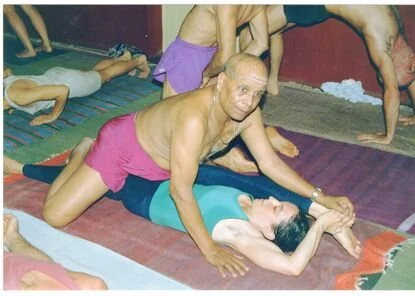
An Alternative to the Guru for the Path of Transformation
In this article, I intend to explore what the traditional guru-disciple relationship was like; how it is no longer valid in this day and age; and what we might replace it with.
This afternoon I’ve been perusing various Youtube videos on Ashtanga Yoga looking for inspiration when all of a sudden I got what I was looking for. I came across this video in which Richard Freeman, a well-known Ashtanga Yoga teacher, is speaking on a panel at the Urban Zen Well Being 2007 Forum. What struck me about that clip was that he was making the point that “it’s no longer the age of the guru;” in fact, a new model is being born in the West in which the relationship of student to teacher is one of “equal partnership on both sides.” In this article, I intend to explore what the traditional guru-disciple relationship was like; how it is no longer valid in this day and age; and what we might replace it with.
The Guru-Disciple Relationship
The role of the guru dates back to the period of the Upanishads, around 1000 B.C.E. Prior to this period, Hindu spirituality was expressed in the act of sacrifice to the gods. The gods were thought to be outside forces that needed to be manipulated in order to maintain order. The Brahmans (priestly caste) were in charge of maintaining the spiritual order in the form of sacrifice.
But by the ninth century, a new revelation began to be expressed. Instead of gods, like Shiva or Brahma, dwelling outside, the gods were considered inner experiences, inner energies that could be met and used for personal transformation. Anyone could, now, have a direct access to the gods. It wasn’t just the Brahmans (priestly caste). The term "Upanishad" derives from the Sanskrit words upa (near), ni (down) and şa (to sit) — so it means to "sit down near" a spiritual teacher to receive instruction in discovering these powers within.
The role of the guru was to illuminate the shishya (disciple) from the darkness of illusion through esoteric knowledge. Gu means to dispel. Ru is the darkness of ignorance. In order for this new revelation to be expressed, the guru’s knowledge needed to be vast. He needed to have been someone who had already awoken from the dream of maya (illusion), awake to the direct experience of the purusa (indweller, soul). Additionally he needed to have been a shishya of a guru, himself and to have received his guru’s blessing to impart the wisdom.
Hierarchical Roles
The role of the shishya’s was primarily devotion, commitment, and obedience. In exchange, the guru taught through discourse, through silence, through medicine, and through imparting esoteric practices. The guru offered what he could to illuminate his disciples into the truth, knowledge, and experience within. But the role was hierarchical. The shishya was in the hands of his guru. If the guru took advantage of his position, then that was the risk the disciple took.
In Aṣṭadaḷa Yogamālā: Articles, Lectures, Messages by B. K. S. Iyengar, the author describes the brutality, at times, of his guru, T.K.V. Krishmacharya, how “his moods and modes were very difficult to comprehend and always unpredictable. Hence, we were always alert in his presence. He was like a great Zen master in the art of teaching. He would hit us hard on our backs as if with iron rods. We were unable to forget the severity of his actions for a long time.” (Iyengar, B.K.S. Aṣṭadaḷa Yogamālā: Articles, Lectures, Messages. Mumbai: Allied Publishers Private Limited, 2006. Print. p. 53)
And in an interview I dug up in my files dating back to 1993, Pattabhi Jois says this about his guru:
My guru was a very difficult man…One example of his callousness, which I tell about is this: on the Sanskrit College’s anniversary day a large celebration was staged which the Maharaja attended. We were to give a demonstration on the ground…There was no podium so my guru told me to do kapotasana (an extreme backbend) and stood on top of me for 10-15 minutes giving a lecture. There was a small tree coming out of the ground that had been haphazardly cut several inches from the ground. The sharp end of the stick stabbed into my shoulder and stayed there, penetrating more and more deeply as the lecture went on…After the lecture I stood up and was covered with blood…For 15 days I could not move my arm.
Imagine the lawsuits that might have taken place had Krishnamacharya been teaching at the local Yoga studio these days? Clearly, times have changed.
Guru Projections
We in the West have an awkward relationship with this sort of authority. We tend to think of the guru-shishya relationship as one of projection. The shishya abdicates power to the guru by projecting all things parental onto him.
I saw this, and even experienced it, first hand when I studied at Pattabhi Jois’ Ashtanga Yoga Nilayam throughout the 90s. Guruji could play the face of our good father quite well. He could also be the fierce father, the tender father, the wise grandpa, and many, many more. Much of the relationship we shared with our guru depended on our unfinished business. In a lot of ways, many of us were working out our daddy stuff with him, whether we wanted to admit it or not.
Today, I have little doubt that most of the projection I had with him had almost nothing to do with who he actually was, but being a great teacher, he willingly took on the various fatherly roles and allowed us to act them out with him in order to move through some of the leftover childhood stuff. While a lot of us got great benefit from this form of relating, I saw some of my fellow guru bhai (disciple brothers and sisters) leave the practice altogether because they could never separate the projection from the man that he was. And some left because when they did, they were sorely disappointed.
Guru or Snake Oil Salesman?
But unlike an authentic guru, who is regarded with great respect in his culture, our teachers in the West are looked upon with a degree of skepticism. We do not have the same opinion of the spiritual dimension that Asian cultures do. In the audio CD, The Roots of Buddhist Psychology, Jack Kornfield describes the experience of being a monk in Thailand and accepting alms from people who could barely feed themselves. The work of the monks was so important and valued, that the lay community would starve to feed them.
We, in the West tend to hold people of spiritual authority, with doubt and distrust. Fundamentally we resist being conned. It is not uncommon to see leaders of spiritual movements initially elevated by their followers and eventually disgraced by those same people. Just look at the recent John Friend-Anusara Yoga and Diamond Mountain University scandals. I don’t know the inside scoop, but what’s clear is that students revere their teachers as if they were gods and then they, somehow, fall off the pedestal. They're human.
But we as a society tend to hold people who run or lead spiritual movements to a higher standard than we hold even our politicians. Because they’re leading us into spiritual practice, they have to be unblemished by any one of the seven deadly sins; in fact, in some way or another they need to be perfect.
However, when you look closely at the lives of some of the great teachers from the East, the so-called illuminated gurus, what we’ll find is nothing but humans, people steeped in tradition and teaching and, at the same time, riddled with human foibles. Chogyam Trungpa Rinpoche, the Tibetan spiritual leader that founded Naropa Institute in Boulder, Colorado, had the reputation of drinking beer all day long and had quite an appetite for young women. Osho, also known as Bhagawan Shree Rajneesh, the founder of Osho Ashram and Rajneeshpuram in Oregon, was addicted to nitrous oxide and also was known for his affairs with his female disciples. Amrit Desai, the yoga master who founded Kripalu Institute, had to resign as director after his multiple extramarital affairs were exposed. My own yoga teacher, Sri K. Pattabhi Jois, publicly fondled his female students genitalia.
Does that make these men any less spiritually advanced? We in the West would like to think so. It’s quite possible that we want to believe that our spiritual leaders represent the perfect parent, the one we didn’t grow up with. The truth of the matter is that we all make mistakes, sometimes even very big ones, ones that hurt others badly. I am thinking, at this moment, of the priests who mistreat(ed) children. Without a doubt, this behavior is inexcusable; however, it demonstrates that we can no longer afford to completely relinquish our power to the charismatic individuals that lead our spiritual movements.
God is Dead
These people are human, just like you and me. Perhaps there was a time when there were gurus who were truly unblemished, but we’re living in a very different period, historically speaking. When Nietzsche said, “God is dead,” what he meant was that we can no longer rely on the church, the mosque, the monastery, the lama, the guru, or even a philosophy for our salvation. For him, these forms of authority had become completely discredited. As a result, it was up to each of us to find our way.
I am not suggesting that we do it alone. We need others to support our growth and development, but when we are always looking for the wisdom, the compassion, and the answers outside of ourselves, we forget that we're just projecting.
It can help immensely to love and revere our teachers while simultaneously never forgetting that that which we love and revere is The Self. Essentially, what I am arguing is that when we take the projections back, when we take responsibility for our own transformation, we stop the game of elevating teachers or the spiritual lineages we come from in a way that does not serve us. Likewise, we also stop being disappointed when our gurus turn out to be human, just like you and me.
Not everyone who comes to spiritual practices, like yoga, looking for the full-promise of yoga. Many just want to get stronger, feel better, or have a positive group experience. There is absolutely nothing wrong with these approaches. However, I am starting with a little bit of theory to point out the fact that the work of personal transformation has the potential be deep and profound. And, in this case, it can be extremely helpful to have a teacher or guide. Not everyone wants to go there, and that’s perfectly fine.
Why Having a Teacher At All Matters
The description that follows is what’s possible from the practice of yoga, as described by Patanjali in The Yoga Sutras, a text dated sometime between the 2d centuries B.C. and A.D. and considered by many to be the authoritative source text that describes the path of yoga. Historically the role of the teacher was to help the disciple to distinguish (viveka) temporal from eternal, relative from absolute, truth from fiction, and light from dark.
The tricky part of this work is that asmita, the ego—the overidentifiaction with I, me and mine—often wants to assert itself. And the truth of the matter is that the ego is not particularly adept at distinguishing truth, eternality, or the absolute. It is constantly grasping to what gives pleasure and trying to avoid that which is uncomfortable. This hell realm is known in yoga and Buddhism as avidya, which can be translated as ignorance or misunderstanding. A lot of the work of spiritual practice is a slow, gentle a dismantling of this misunderstanding associated with this excessive 'I-clinging.'
One might argue that the role of the guru was to make sure that this 'I-clinging' didn’t get in the way of the process of realization. That’s why most traditional schools of yoga or Buddhism emphasized the teacher-student relationship and not the practice of postures or meditation, alone. Without a teacher the aspirant risked misleading him or herself. He or she risked being led around by a craving for pleasure (raga) and a repulsion of discomfort (dvesa).
For Patanjali, yoga wasn't about feeling good, nor was it about feeling bad, either. It was a game of noticing that which was beyond pleasure and pain, clinging and aversion. It was a game of noticing essence, truth, and the absolute through a long, steady process of discernment. According to Patanjali, this process takes continuous practice (abhyasa) and the skill of non-clinging to pleasure or aversion to discomfort (vairagya) to be able to see clearly (1.12).
Very few of us naturally have this discipline. It's not easy to be with discomfort. Many of us can be with some discomfort. Few of us can be with it for extended periods of time. Nor are we apt to give up our 'I-clinging.' The process of letting go of what we cling to and being with what we’re averse to is counterintuitive. Additionally, the role of the guru presupposes that no matter how earnest we are, we can all get pretty slippery from time to time, and this can take us off of the path, even when we think we're on it. In other words, it can be pretty useful to have a relationship with someone who is committed to our growth and transformation, someone who can offer an honest reflection and guidance, too.
What Qualifies a Teacher?
And yet, we're living in a time when none of our teachers are fully illuminated. So what kind of criteria do we employ to choose someone to teach us? Do we choose a teacher because he or she has been on the path longer than we have? I don’t think that this is a valid reason to study with someone. Length of time does not qualify someone to be a teacher. So what standards shall we use to determine the qualification of a teacher?
▪ Years of practice?
▪ Years spent with the leader of the tradition?
▪ Displays of mastery?
▪ Teacher trainings?
What determines a qualified teacher? How the heck are we going to experience the full promise of yoga without someone who's qualified? And how are we to determine those qualifications?
Collaborative Relationship Designing
The problem is that it is impossible to be qualified to be a guru in this day and age. Gurus are 'fully-cooked,' so to speak. And most yoga and meditation teachers aren’t even close. We all have some clarity and a lot is still obscure. And while some of the prerequisites I list above can be helpful, I don’t think that any one of them can prepare a teacher to support a student on their path.
So I am starting with a basic premise: no one is perfectly qualified for the role of a teacher. Everyone in that role will be imperfect, flawed, and will make mistakes. It can be extremely helpful to start from the most basic recognition that our teachers will be and are human, people with good intentions who might fail us, nonetheless. Given that, how do we find ourselves in loving, trusting relationships with a teacher that can support us in our evolution along the path of yoga?
It starts with an agreement that I call relationship design. In relationship design, the context for a relationship is spelled out. In other words, it is a conscious contract that provides clear boundaries and a sense of direction for both teacher and student. When the agreement isn’t clear boundaries are crossed that can do damage.
I once had a really bad experience with a teacher in which I abdicated my own common sense in favor of my teacher’s common sense, thinking that her’s was ‘more enlightened’ than mine. By doing so, I made a decision that went totally against my own code of ethics. As a result, it kind of ruined me for a period and destroyed some significant relationships that meant a lot to me. Had we designed clearer boundaries along with the space where I could struggle with decisions myself, I might not have had to experience that suffering.
As a result of that experience, I am acutely aware that as a teacher, I cannot presuppose anything about my students wants or needs. In other words, I don’t know what’s best for my students. I am constantly asking my students to design with me what they need.
So when it comes to the relationship of teacher and student, it can help the process immensely for that relationship to be crystal clear. When it’s clear, both student and teacher can feel confident in their respective roles. The more committed student and teacher are to staying in communication, even and especially when the going gets rough, the more powerful that relationship can be. The more communication around the structure of that relationship, the safer it is for the student to delve inward and to know that he or she is supported. Additionally, it is critical that the relationship be continually tended to and be kept tidy. At the end of this piece, I give an example of how to start the conscious design of a student-teacher relationship. Have a look. Give it a try.
Humanity as the Doorway to a Sacred Friendship
Given the premise stated above, that no teacher is perfectly qualified to teach, it can be immensely helpful if both teacher and student start by recognizing the sanctity of the relationship. This relationship has the potential to be a form of yoga itself. It has the potential to be something quite unusual. It is one rooted in collaboration and based as much as possible in agreement, transparency, and intimacy. When both teacher and student fathom the honor of the relationship, both naturally hold one another to a particularly high standard.
In the few times that I taught classes for a friend in Tokyo, I have been struck by the way Japanese students regarded the sensei. As the teacher, I sensed the students’ reverence in a way that we in the West have difficulty comprehending. Given the level of surrender these students demonstrated, it would have been quite possible for me to take advantage of the situation, but I personally found it the case that I couldn’t help but step up in a way that I’d never stepped up as a teacher before. It was a great honor to be held as an authority, one that I couldn’t help but want to meet.
Likewise, I’ve experienced students walking into my classes with a sort of disregard for the role of the teacher. That’s perfectly fine. Not everyone would like a teacher, and many of us have experienced wounds at the hands of teachers. At the same time, without a regard for the sacredness of the roles, the teacher-student relationship takes on the quality of being a financial transaction, “payment for poses,” kind of a boring way of relating.
So honoring the sacredness is one part to this premise. Another part is that because the teacher is never perfectly qualified to teach, he or she can be regarded as human, warts and all. Some of us want our teachers to be extraordinary, but they're not. This is a real set up for failure, the teacher failing the student and visa versa. But when the student can recognize and interact with the teacher’s humanity, a true connection can start to be established, one that encourages a quality of human-centered friendship. It is rare to have a relationship where one’s humanity is honored. Very few of us experience relationships where we have permission to share all of ourselves and all parts are welcome.
Another boon associated with recognizing the teacher’s humanity is that it allows for both the teacher and the student to make mistakes. Relationships where mistakes are valued are dynamic and creative. Both people aren’t afraid to try things, to mess up, and to have breakthroughs. If the teacher has to play-it-safe for the sake of not upsetting the relationship, the relationship lacks a sort of dynamism that’s necessary to face the tough stuff that comes up on and off the mat.
The Shadow: Trust and Transparency
Both students and teachers have their limits of what they’re capable of working with in the shadow-work that shows up in the relationship. Playing with this edge can be very useful. For the teacher to take the student past the student’s edge, he or she must be confident in that territory him or herself. The teacher has no business shoving students into areas that are unfamiliar to the teacher. Below, I describe the prerequisites of teachers: self-study, peer feedback, and mentor feedback. All of these ensure that the teacher is doing the inner work necessary to support their students when they enter unfamiliar and uncomfortable territory.
Because the work of transformation confronts some of our most intimate spots, the student must be able to trust the teacher as much as possible. And so there has to be agreement between the teacher and student such that the student grants the teacher permission to head into a particular area, especially areas that feel vulnerable or scary. All it takes is a simple request, like “Is it okay if we go here?” Sometimes it can be helpful to create more dialogue before entering in.
In my first year as a yoga teacher, I ran into a situation that I am not proud of but feel that it’s pertinent to share. I had a student who was very, very proficient. I thought, “This guy is good. Let’s keep him going!” So I kept giving him pose after pose. Eventually he started to say stuff like, “I’m good. I don’t need any more, now.” But I kept adding poses on. At some point, he stopped coming to class, and I found out through the grapevine that he’d had a psychotic break that he considered a ‘kundalini rising.’ I was pushing, thinking that I knew best, when, in fact, he knew better. That experience taught me a lot about both trusting the wisdom of my students and keeping the conversation clear.
Throughout that work, it can be helpful to be transparent. Transparency isn’t just in the hands of the student. It can be extremely helpful and useful for the teacher to share when they’re confused, concerned or scared in relationship to what’s happening with a student. If the teacher has to pretend to be okay when he or she is not okay, it creates a low-level of distrust in the relationship. Transparency feels counterintuitive, but it’s honest. And being honest is an incredible gift that the teacher grants the relationship. It creates trust. When there is trust in the relationship, students and teachers enter into an intimate dialogue that is not misconstrued or taken advantage of by one or both parties. When there’s a lot of trust in a relationship, there is no telling what's possible for the student.
Selfless Service
The role of the teacher can be tricky. Occasionally students adore their teachers. Sometimes they loathe them. If the teacher is caught in the ‘popularity game,’ he or she will end up being manipulative. I've been caught in it, myself, from time-to-time. Occasionally, I will notice myself trying to use my charm to get students to like me. Once again, I am not proud of this, but it happens, and I don’t think I am the only teacher that’s fallen prey to wanting to be liked.
My proudest moments, though, have been when I've seen a student uncover something she or he'd been confused about or struggling with; when I've seen him or her diligently stick with something even when it was really uncomfortable; and in those moments when his or her wisdom, brilliance, and insight emerged with more clarity than that of a diamond.
In these moments my focus was not on me but on my students and their discovery process. That doesn't mean that I was perfectly objective, neutral, or impersonal. It just meant that my stance was first and foremost about my students, not about getting my personal wants and needs gratified. In short, the role of the teacher is one of self-less service for the sake of evoking the student’s evolution.
In Service to Evolution/ Granting the Respect of Autonomy
Part of the challenge this relationship faces is the fact that the student is paying the teacher to provide a service. In most service positions, the role of the server is to provide both care and comfort. While care and comfort may be useful qualities to cultivate in a teacher-student relationship, they cannot be the only qualities. If the student’s aspiration is transformational, then the relationship has to have room to be edgy and uncomfortable, as well. Without that, the relationship remains a ‘feel-good space,’ and this doesn’t really have anything to do with this path of distinguishing (vivieka) misunderstanding (avidya).
The teacher’s primary responsibility, then, is to the evolution of his or her students, not to the perpetuation avidya. This is where the role of the teacher can get tenuous. Manipulative teachers have been known to take advantage of this aspect to the role of the teacher. They’ve justified narcissistic behavior as something that’s “best for the student” when, in fact, it’s actually best for the teacher.
Being in service to the student’s evolution means that the teacher isn’t always in agreement with the student and is granted enough trust by the student to assert what needs to be asserted for the student’s growth. At the same time, the teacher grants the student the respect for their capacity to make decisions. Decisions of the student are of their own choosing and those decisions have to be respected.
Presupposing Our Students are Whole Rather Than Broken
Early in this discussion, I was speaking of the basic premise that no one is perfectly qualified for the role of a teacher. Similarly, it might also be useful to start from another premise, that students are whole and complete. They’re not broken. They don’t need to be fixed. In fact, the role of the teacher is to empower the student to trust him or herself, especially those parts that are innately wise, compassionate, and clear. This is a very unusual premise.
In most teacher-student relationships, the role of the teacher is to presuppose that the student has something wrong that needs to be altered, changed, or reworked. Rarely is this, in fact, the case. In the years that I have been teaching, I have rarely come across someone looking to be put back together again. When this is the case, psychiatry and psychotherapy can be extremely useful adjuncts to yoga therapy. But more often than not, students that have shown up to my classes are resourceful enough to make good decisions. Sometimes, it can be helpful for me to offer my expertise or to ask questions. Ultimately, I leave the decision in the hands of my students. If I regard my student either as broken, confused, or lost, it can be nearly impossible for him or her to access his or her own clarity. If the student cannot trust that something within is innately wise, then he or she will remain lost at sea.
I personally have had mentors and friends that have wanted to fix me at certain low-points in my life, people who had very good intentions, in fact. The problem with those relationships was that I would often abdicate my will to them, and while they may have steered me away from dangerous rapids, I never learned to either ride the rapids or to identify them in the distance.
When I can cultivate my students' confidence in their decision-making capacity, magic begins to happen for them. They begin to trust the wise parts of themselves to lead with clarity. So much of the baggage my students come in with is not from being egotistical. They don’t need to be knocked down and then eventually rebuilt. On the contrary, most of my students struggle with a degree of self-doubt, lacking the confidence that they know how to make good, sound decisions. When a teacher can cultivate a student’s innate strength, the process of clarifying (viveka) can take place.
Prerequisite: Svadhyaya: Continuously Growing and Evolving
If a teacher is not actually walking the path, he or she probably shouldn't be teaching it. Now, there's a lot of wiggle room in terms of what that means. If, for example, a teacher has a knee injury and doesn't practice various asanas, it doesn't mean that he or she is not qualified to teach. That's too literal a translation. The essence of what I am suggesting is that a teacher needs to be growing and evolving and in self-study (svadhyaya) in order to be able to help his or her students sort out their struggles. That really must be a prerequisite to teaching.
Prerequisite: Peer and Teacher/ Mentor Feedback
Another prerequisite must be that a teacher has a teacher or mentor of their own and a peer body to get honest feedback from. If the only people a teacher receives feedback from are his or her students, he or she risks becoming narcissistic or bipolar. Sometimes students love the teacher. Sometimes they don’t. And student feedback is biased, by nature. Peer and mentor feedback is not.
I've been very lucky in my years of teaching. I have had some smart teachers that I've partnered with who I've given permission to give it to me straight. It doesn't always feel so good to know when I am off base in a particular situation, either with a student or in the classroom, but with that feedback, I've learned a lot.
Having peers also gives one a sense of camaraderie, the sense that while the experiences of teaching are different, the essence of it is the same. I often find it comforting to have a space in my peer relationships where we can commiserate about the ups and downs of teaching. It normalizes experiences and situations where I do not feel confident.
Finally, having a teacher or mentor is critical for most teachers. It can be extremely useful to have someone to share confusions with, to seek clarification from, and to learn the art of deeper inquiry. Teachers need teachers and peers! These simple measures ward off the possibility of vainglory, a common pitfall associated with being in any role of authority.
A New Conversation
We’re living in different times, spiritually speaking, now that the age of the guru is over, but that does not mean we cannot experience the promise of yoga. It just means that we have to get a little creative. What I’ve presented above is very preliminary. I welcome all of your feedback. I have no intention of this being a ‘final statement,’ but, instead, something to evoke a conversation, something that we as a community have the courage to struggle with.
The Sangha May Be the Next Guru...
Before I end, I want to share a suggestion that Ken Wilbur posited, that the new guru is the sangha or community of like-minded individuals on the spiritual path together. I have actually had several experiences of living in and amongst communities. More often than not, there is no uniform agreement within it to use it as a tool for transformation. When there is, however, the experience can be absolutely brilliant and searing, at the same time.
I notice that we’re in a time when we long for community and yet we’re all frightened of it, of exposing ourselves and of being exposed. Likewise, many of our most painful moments have been in community, so we all have a lot of wounding around community, as well. But we’re also lonely, disconnected, and disjointed. And community can be a powerful place to reconnect, again. That’s why I think Wilbur might just be right. It might just be the perfect opportunity to wake us up to our true nature. Your thoughts?
Exercise: Designing a Relationship With Your Teacher
It may seem a bit artificial, at first, to have a ‘sit down’ with your teacher, especially if you have an ongoing relationship with him or her, however, the results can be very powerful and pivotal for you, him or her, and your practice. By the way, the design doesn’t end after the first conversation. It is constantly being re-negotiated. That way, the relationship remains both flexible and tidy. Below are just a few pondering questions that may give you a sense of what might be shared in such a conversation.
What exactly do you need and want from your teacher? From your practice? For yourself physically, emotionally, spiritually, etc.? If your relationship with him or her were to have a huge impact in your life what would it look like?
What’s your sense of what will really support your growth in the practice?
How do you want your teacher to handle you around risk taking? Does it help to push you, to be gentle with you, or to be somewhere in between?
When and how do you tend to get evasive? Do you stop coming to practice? Do you get angry? Do you shut down? How do you want your teacher to be with you when you do?
Where do you usually get stuck, either in your practice or in relationship? When you are stuck, what can he or she say that will bring you back to the present moment?
What does your teacher need from you in order to support your evolution?

Sharing Words of Appreciation
Finding language that lets the people we love know they’re loved.
A client has recently begun asking her boyfriend to tell her that he loves her. When she introduced this idea of requesting that he verbally appreciate her, he responded: "I'm with you, aren't I? If I wasn't with you, I wouldn't love you. Isn't that enough?"
No, that's not enough. The honest truth is that we need to know that we are cherished. We need to know that we're treasured by those people around us. I'm about to get a puppy, and so I've been doing all sorts of reading about how to train and interact with her. What's clear to me is that we're a whole lot like puppies. While we don't thrive from being rewarded with kibble, we do thrive when our essence is recognized.
Open-Hearted Seeing
Our essence is who we essentially are at the depth of our being. Merriam-Webster defines essence as " the individual, real, or ultimate nature of a thing." When we value another's essence, we're not just acknowledging the qualities of an individual that are unique to that individual, we're acknowledging who they elementally are to us in that moment.
To detect essence, requires a quality of open-hearted seeing. We need to be able to look with appreciative eyes. Noticing essence is distinct from noticing something that that person has done or that they have. Being appreciated for doing a job well-done feels good. Being acknowledged for who we are essentially feels amazing!
I See You
So my client showed him how she wanted to be acknowledged. So often we ask our significant others to just guess how we want it. We ask them to be mind readers, to just know. Most of us need to be taught this. As advanced as our culture is scientifically, we have some catching up to do when it comes to emotional intelligent behavior.
In order to show him, she looked at him for a second or two, connected with his essence and said, "You are a deep, sensitive, and sexy man." When she did, she said that she saw him melt, that all of his defenses came down.
Why? Because he was seen. When we share our appreciation for another, we're basically saying, "I see you, and I love what I see." So rarely do each of us have the experience of truly being seen or known. When it happens, it's like a healing balm. Truly being known, being seen, is what each of us longs for.
Creating Connectedness
Once people learn how to acknowledge, they start to see how powerful it is. It's powerful because it creates a sense of connectedness. People around us feel connected to us when they know that they are seen. And when they do, their best comes out. But there's a timing to it. I know people who acknowledge so much that it loses its potency.
In addition, there are times when it should and should not be used. The bottom line is that it has to come from an authentic place. We all can sense an authentic boiling up of love, care, or affinity for another. It's in those moments when we feel or sense that that acknowledgement can and does create connection. When it's used in the form of manipulation, it feels saccharine and manipulative.
And there are recipients, who no matter how authentic our words of appreciation are, have a hard time receiving. Some people just have a hard time being admired. To receive words of appreciation are seen as prideful. When that's the case, no matter how authentic our words, they will never land.
Each of us must develop the capacity to express our care for one another. It has to come from an authentic place. And, at the same time, that care must be backed with acts that represent that care. The two have to occur, not necessarily simultaneously, but without action, words are just that, words. When our word and action are one and the same, our expressions of love and care for one another are powerful and transformative for all to see. The very few relationships that I've seen that express a depth of caring consistently marry both words and deeds. At the heart of their expression is care.
The Basics: How to Share Appreciation
Start to pay attention to those moments when you sense love, care, or affinity for another. That's often the best time to acknowledge them. If you're not habituated to noticing this sense of love and care, make that your practice for a week. Notice each time it arises.
Once you notice it, give expression to the feeling. You might say, "I feel love for you," or "You make me feel warm inside," or "My life feels whole with you in it," or "I really appreciate the joy you bring to my life."
Next, take a moment to look in the direction of the person. When you look, you're looking with a different set of eyes. You might say that these are the eyes of appreciation. You want to notice, in the moment, what you deeply and profoundly appreciate about the other person. Remember, it's just a moment. Don't take too long. Essence is obvious. If you keep looking for something, you will totally miss the mark.
Next, offer your appreciation in a "You are..." statement. For example, "You are a bright light who brings warmth wherever you go," or "You are deep soul," or "You are gorgeous." Because essence has a poetic quality, metaphor can be a powerful form of acknowledgement.
Once you've offered a "You are..." statement, don't keep talking. Pause and notice how your words landed. Were they received? Were they blocked or deflected? And if they landed, notice what's present between you and the person your acknowledging. Is there more love and affinity?